Advice on prepping and painting interior wood

steve yates

Well-Known Member
Joined
16 Oct 2014
Messages
4,114
Location
Benfleet, Essex/Keswick, Cumbria
Visit site
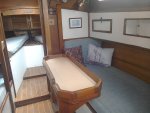
We’re going to restyle the interior of the longbow,
I like the teak surrounds but hate the ugly veneered panels. How would you prep the surface and what kind of paint would you use?
If not painting the teak ( we’ll decide on that when my wife settles on the colour scheme for inside) what would you do to it? If anything.
 

Attachments

  • E45856F2-A923-4295-8B37-8DACAC77777F.jpeg
    E45856F2-A923-4295-8B37-8DACAC77777F.jpeg
    861.7 KB · Views: 115
Every time this topic comes up, I wait with baited breath for a first hand account of someone who’s done interior paint properly!

By that I mean high gloss, gelcoat-style, durable, ideally waterproof (for shower/heads).

In the absence of that (apart from the Sandolin/Danboline/etc. crowd - no offence intended!), I’m pondering whether something like topside paint would work? (International Perfection Pro, for instance).

We’ve got a lovely teak veneer interior, mostly in good shape, but a few panels are unsalvageable and I also want to refinish some pea-soup coloured gelcoat on the moulded grp bits.
 
I wanted some white areas in my 100% wood interior but also had an adversion to white paint as it yellows and cracks on joints.
I bought some white sticky backed vinyl and used that in the end. Still have the original varnish underneath and now have a great zero maintenance finish
 

Attachments

  • 1613838339635-1672155209.jpg
    1613838339635-1672155209.jpg
    150.8 KB · Views: 87
I painted the whole interior of a 40 foot canal narrowboat in the 70's.

We used a few coats of a good primer/undercoat to seal and fill the surface grain, a good rub down and flat with wet and dry followed by two coats of red coach enamel, Tecaloid IIRC.

It looked very good four years later and had hard and extensive use. It was, of course, easy to touch in scrapes and scratches.

First mate was very handy with applying the decoration in traditional manner - Roses and Castles - which broke the red up a bit.

We were often complimented by others on the interior finish.

Which, apart from being hardwood trimmed plywood, was nothing like a yacht..................................... :cool:
 
Every time this topic comes up, I wait with baited breath for a first hand account of someone who’s done interior paint properly!

By that I mean high gloss, gelcoat-style, durable, ideally waterproof (for shower/heads).

In the absence of that (apart from the Sandolin/Danboline/etc. crowd - no offence intended!), I’m pondering whether something like topside paint would work? (International Perfection Pro, for instance).

We’ve got a lovely teak veneer interior, mostly in good shape, but a few panels are unsalvageable and I also want to refinish some pea-soup coloured gelcoat on the moulded grp bits.
Depends on what you mean by properly. steve was not asking about loo and shower compartments which indeed are a challenge. You can indeed used yacht exterior paint either one pack or 2 pack. They are by definition waterproof and glossy and can be used on both GRP and wood. However I don't think they are suitable for painting wood furniture panels or bulkheads as in steve's photo.

Richard Hare who has written on this subject (and anything to do with coatings or wood care) many times in PBO and Classic Boat recommends the type of paint I suggested for internal use.

He built his boat from a hull and deck and th interior shots will give you an idea of what can be achieved, particularly the shot of the loo compartment
Golden Hind 31 Used Boat for Sale 1998 | TheYachtMarket

These are the interior of Tranona using Dulux acrylic for the white, except the forecabin which is in Dulux Matt emulsion as an experiment and all the wood in Ronson Satin polyurethene. Much of it is over 20 years old when I sold the boat just over a year ago

IMG_20190718_181056.jpgIMG_20190718_181005.jpgIMG_20190718_181031.jpgIMG_20190718_181202.jpgIMG_20190718_180918.jpg
 
Last edited:
Depends on what you mean by properly. steve was not asking about loo and shower compartments which indeed are a challenge. You can indeed used yacht exterior paint either one pack or 2 pack. They are by definition waterproof and glossy and can be used on both GRP and wood. However I don't think they are suitable for painting wood furniture panels or bulkheads as in steve's photo.

Richard Hare who has written on this subject (and anything to do with coatings or wood care) many times in PBO and Classic Boat recommends the type of paint I suggested for internal use.

He built his boat from a hull and deck and th interior shots will give you an idea of what can be achieved, particularly the shot of the loo compartment
Golden Hind 31 Used Boat for Sale 1998 | TheYachtMarket

These are the interior of Tranona using Dulux acrylic for the white, except the forecabin which is in Dulux Matt emulsion as an experiment and all the wood in Ronson Satin polyurethene. Much of it is over 20 years old when I sold the boat just over a year ago

View attachment 109657View attachment 109658View attachment 109659View attachment 109662View attachment 109663
Thanks for sharing those. And don’t get me wrong, the effects look good and I’ve read and seriously considered Richard Hare’s arguments for Sadolin Superdec in particular.

I’m a fan of anything affordable, (comparatively) easy to apply, and effective like ‘water based’ house paints (be those alkyd/acrylic or both). Even Danboline has excellent qualities and maybe the application could be ‘refined’ to get a very decent finish?

But I’ve also had good experiences with single component urethane paints - I did a van in ‘Combicolor’ using rollers and a bit of wet/dry and it looked close to a decent 2k job. If it can survive UK road conditions for 5 years and counting now, I wouldn’t mind the idea of reproducing something like that - in select ‘heavy duty’ areas like around the galley/hob and the heads - down below.

‘Exterior’ marine paints, in their various 1 and 2 component guides, would presumably have similar qualities? But I appreciate could be an unnecessary faff (and can be nasty stuff to work with in confined spaces).

There are sometimes oils, solvents, fuel and other nasty stuff splashing about down below on our boat. Maybe shouldn’t be so, but that’s how it is! She’s a ‘rolling’ project... ;)

I’ve also considered Formica. They do some lovely finishes. But I’ve never laminated ‘veneer’ like that and it’s technically quite intimidating, compared to roller painting which is easy to do well.

In answer to the OP’s question - I would seriously look at the Sadolin Superdec. I might go for an epoxy high build primer after a basic clean/key sanding, with a few coats and a sand down in between to flat it off. Use more paint or filler on low spots, if you’re fussy (like me!). Then the Sadolin as per instructions. Gloss or satin, depending on taste. Job done!

And for the teak you’re keeping, consider @Concerto ‘s method for refinishing with Westerly factory-spec laquer. It looks boss! Search on here, you’ll find his posts.
 
Sadolin superdec is great for sawn wood. The rougher it is the better it works.. It has a similar consistency as emulsion paint.. It gives an excellent finish on cladding, fences and similar but not something i would chose for a boat interior. It last well on exterior wood but is rather pricey !
I fitted a new large door blank to a opening that suffers from weathering and lots of traffic abuse. Its time consuming painting it correctly so decided to try superdec as it would make it so much easier to paint when it needed redoing. Took 4 coats .. The finish will never be as good as an oil painted finish. It does appear to be lasting though.
Yes you can use a topside paint and with lots of sanding can achieve a mirror like finish.
Two pack can attack a single pack finish if applied over it.
 
As I heard my name was being mentioned perhaps I should answer to Steve.

Firstly guess what I have been doing this afternoon. Using a cabinet scrapper to remove the old lacquer from a hanging locker door from Concerto. Having seen the condition of the 40 year old lacquer, I would recommend complete removal of the lacquer before applying any paint as the lacquer was quite easy to remove. If not any paint finish may easily be dislodged or may have a poor bond between the lacquer and paint, and you will have to strip everything off and start again.

Steve you would not have a teak interior but a sapelle and mahogany as Westerly did not start using teak until 1982. If the plywood is badly stained then painting can brighten up the cabin and Tranona's advice on paint is worthwhile following.

Steve I assume you are a WOA member, if so then on Wednesday evening I giving a WOA Zoom presentation of refurbishing woodwork and fitting new foam backed vinyl headlining. There will be a PowerPoint presentation with lots of photos and advice on how to get an original finish in your boat. This will be added to the Westerly Wiki and for non members of the Westerly Owners Association I will add a link at the end of the week on this forum so you can all see it.
 
It depends how much time you want to spend, how good a finish, etc. but for quick & easy with acceptable (to me) results I did a quick refresh of the forecabin and head using Zinsser BIN shellac based paint as an undercoat on varnished wood. This stuff will go on to any hard, shiny finish without preparation. You can see it in this video...
 
Sadolin superdec is great for sawn wood. The rougher it is the better it works.. It has a similar consistency as emulsion paint.. It gives an excellent finish on cladding, fences and similar but not something i would chose for a boat interior. It last well on exterior wood but is rather pricey !
Can’t say I’ve ever used it myself, but I think what Richard Hare was recommending was an ‘off specification’ use of Superdec for interiors... I wonder if the consistency and opacity (designed for exterior sawn wood, as you say) were in fact what made it work well for interior use?

I can’t remember where I read a PDF of his original article on this and can’t seem to find it now via Google. Maybe someone had even posted it on here?
 
Can’t say I’ve ever used it myself, but I think what Richard Hare was recommending was an ‘off specification’ use of Superdec for interiors... I wonder if the consistency and opacity (designed for exterior sawn wood, as you say) were in fact what made it work well for interior use?

I can’t remember where I read a PDF of his original article on this and can’t seem to find it now via Google. Maybe someone had even posted it on here?
Difficult to see how that product could have any benefits for interior use when it is formulated for use on softwoods exposed to high UV and wide variations in temperature and humidity. There is little difference between the interior of a boat, particularly a modern one and a house. Equally, the only advantage of using so called "yacht varnishes" is to get a mirror finish, although often the last coats are satin. You can achieve similar finish for a fraction of the work with household interior finishes.
 
Difficult to see how that product could have any benefits for interior use when it is formulated for use on softwoods exposed to high UV and wide variations in temperature and humidity.
I don't know! We'd have to find Richard Hare's original article (I think it was a test or review of various options and Superdec definitely won).

As I've said, I'm not ideologically opposed to interior/house coatings by any means. Although our interior is definitely a heavier duty application in some respects (it's a 'dry' boat for the most part, but we have 'slylight' windows in the coachroof that let in a lot of light and tend to bleach/yellow things more than average, there's also occasional oil/solvents where they shouldn't by as mentioned, etc.).

Plus as much as I can see the easy of application advantages for domestic interior coatings, I also like paint 'systems' that - once you're familiar with them - you can deploy relatively easily in a range of applications. Jotun's various ranges being my favourite examples. In fact, I plan to consult SML and see what they recommend for a shiny, durable, topcoat finish (as a very happy customer who's taken >50L of their product over the past year alone!).
 
Some does appear to be melamine or similar as your wood shows signs of its coating coming off but other parts still look in good condition which may be the melamine .
You could certainly sand the wood back to bare and re varnish.
 
It is Sapele faced ply As you can see from the shots of the cabin of Tranona I like the mix of sapele and white with solid trim. consider keeping the sapele panels and bulkheads and doing the locker doors and the sliding ones above the bunks in a contrasting light colour. The solid trim such as round the galley will respond well to stripping back to bare wood and varnishing with a satin finish.
 
Is it definitely a laquer on these boats? every time I look at it I just think, thats melamine!
Westerly definitely used the Morrells lacquer I quoted earlier. However since being built a previous owner may have used another finish like varnish. On my Fulmar Concerto, some places had a different coating, hence why I am going back to bare wood. My main bulkhead has a thick coating that is soft and can be pealed with a finger nail. The lacquer is unlikely bond to a varnish or other finish. The worst problem is when someone decides to wax the woodwork as this stops any new coating from bonding.

Morrells are a British company that manufactures finishes mainly for the furnitre trade. They have a chain of trade counters all over the UK. One big advantage is the materials do not have a "marine" price tag.
 
It is Sapele faced ply As you can see from the shots of the cabin of Tranona I like the mix of sapele and white with solid trim. consider keeping the sapele panels and bulkheads and doing the locker doors and the sliding ones above the bunks in a contrasting light colour. The solid trim such as round the galley will respond well to stripping back to bare wood and varnishing with a satin finish.
If the sapelle is what I think looks like melamine on the panels under the sink, (which is what the bulkheads are) then sorry but no way is that staying, I think it's hideous :)
And I don't see any of it in your pics of tranona, which look great.
Definitely painting the locker doors, yes, and will either do them to match the trim which we'll oil or varnish, or we'll paint the trim to contrast. Undecided on that.
 
Does not show well, but the tops of the main bulkhead and the coachroof sides are sapele. Highly prized at one time, but no reason to keep it if you don't like it!
 
Top