Adverc battery controller

MikeBz

Well-Known Member
Joined
22 Aug 2005
Messages
1,807
Location
East Anglia
Visit site
Refitted professionally repaired and tested alternator to friend’s boat today. When we ran the engine we were only seeing 12.5V at the alternator output and ~2.5A going in to the batteries. There is an external Adverc regulator which connects to the -ve side of the field coil via a wire added in to the alternator’s regulator (none of this has changed), so it looks as though either the Adverc isn’t behaving or there is a problem with the wiring to it. Left the engine running for 20mins in case it’s a soft start controller, no change. Spoke with the guy who repaired and tested the alternator, he suggested disconnecting the wire from the Adverc and connecting it to 0V which is where it would be if the Adverc were not fitted - bingo, 14V from the alternator.

The Adverc is buried deep in the engine bay, I can only get a picture of it holding my phone at arm’s length:


IMG_2025-09-09-174107.jpeg

No visible model or part number - can anyone identify it and point me at instructions/wiring diagram?

I’m wondering whether to semi-permanently bypass it by leaving the wire coming out of the alternator connected to 0V. Obviously he then doesn’t get the advantages of a working external controller.
 
Further thoughts… If the built in regulator is negative field control then connecting it to 0V will result in the alternator producing the max voltage it can for the load applied. So potentially could go to 16V + if the batteries are well charged. But the guys at Nacton Auto Electrics reckon the regulator is modified to be isolated earth by removing tracks from the -ve brush so that they don’t contact the body, and rely on the add-on wire being connected to 0V to make it work. But for negative field control that wouldn’t make sense.
 
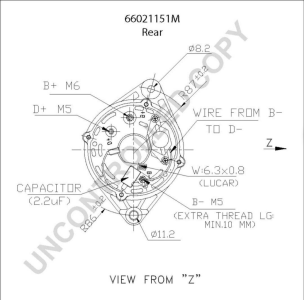
This pic (thanks to PabloPicasso) is from my earlier thread:

1757452801832.png

“Wire from B- to D-“ looks as though it is there to provide 0V to the field winding in the isolated earth case. Which means it must be positive field control? So why would that be connected to the Adverc? Something doesn’t make sense here, to me at least.
 
From memory, what the Adverc tries to do is boost alternator voltage based on the voltage measured at the battery by replacing the built in reglator. This made sense with alternators whose regulator limited them to 13.4 or thereabout, thus giving a higher (bulk) charge voltage at the battery. This was mostly to overcome the volt drop from diode based charge splitters.
 
From memory, what the Adverc tries to do is boost alternator voltage based on the voltage measured at the battery by replacing the built in reglator. This made sense with alternators whose regulator limited them to 13.4 or thereabout, thus giving a higher (bulk) charge voltage at the battery. This was mostly to overcome the volt drop from diode based charge splitters.
Yes that is my understanding. What doesn’t make sense to me is that if the built in regulator is +ve field control, which it must be if by default the -ve brush is wired to 0V (as per the pic earlier), then the Adverc can only reduce not increase the output if it is connected to the -ve brush - which it is. I’m wondering whether it was never properly set up in the first place (it’s been there for years). If it’s a -ve field control Adverc then it’s no use at all here?
 
Top