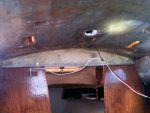
Achilles 24 soggy cabin roof

LP1

Well-Known Member
Joined
15 Dec 2013
Messages
80
Visit site
I can post pictures if you like, but what would you do, repair from above or below?

I have watched this -http://boatworkstoday.com/archives/1088 - and the other follow on videos, and also read threads about repairing from below.

Mine is quite an extensive area (most of the cabin roof) so was thinking of going the boatworks route.

Thanks.
 
You have loads of stuff on that small coachroof.

Garage for Hatch
Raised plinths for hand rails
Mast Step
Winches and Cleats
Fwd Hatch hinges and latch

I would guess that it has either
Stressed, and let go
Got water in from one of the above, and let go
Delaminated due to poor lay up

I would suggest you find out why before proceeding with a repair plan..

Drop the headlinings and get a heater or dehumidifyer going. Whatever you do it needs drying out..

A good investigation will save time and money... Good Luck!!
 
As a former Achilles owner I'm a bit surprised about the idea of a soggy roof. Maybe some clarification of your problem might help.

The really important bit is the forward bulkhead, which supports the mast foot. This is pretty important for the whole boat.

If this is not giving the mast foot the necessary support because it has 'failed', then you are looking at an extensive, but not out of the question repair. It will involve a lot of work to get the old bulkhead out and lots of fibre glassing to get the necessary new bits installed properly.
Now is probably not the time to be taking on that.

Does depend on just what you mean by soggy and where it is soggy. Also depends on whether you carry a few more kilos than the average. Several areas of our Achilles were reinforced to overcome the bendyness that we experienced, especially on the cockpit floor and the cockpit lockers.

Do tell us more .....
 
IMG_0168.jpg

water has got in from one or more of the deck fittings. The water does not come through to the inside of the boat anywhere obvious, but the cabin roof, especially on the starboard side is black and flexes easily when pushed, and has a dull thud when tapped with a hammer.

Now I know that all the deck fittings have to come off. I haven't touched a thing. I have looked on the Achilles website, have joined the flikr group and been on here.

I'm about gathering information at the moment, 'cos as has been mentioned, it's too cold to work with resin.

I just wondered if anyone had any experience of, or preference for working from above or below.

The repair done on boatworks today looks effective, but involves more cosmetic repair. There are photos on the Achilles Flikr site of someone sticking large panels of ply from underneath, then re'glassing the whole lot.
 
Yeah i am going to have to move her off the sea front and into a shed somewhere. It's the only way to get her dry enough.

Thanks.
 
Hi LP1, I have replied to you on the Flickr site. I agree that you should cure the leaks first. Ours came through the deck gland for the cables that go up the mast. We also took the mast down, undid the bolts holding the bulkhead to the deck beam, very gently jacked up the beam to correct the sagging roof, redrilled the holes and replaced the bolts with a larger size.

Rod
 
Yeah i am going to have to move her off the sea front and into a shed somewhere. It's the only way to get her dry enough.

Thanks.

Hi, even if you can get power to the boat and wrap her well in tarpaulins, tied down with cheap roping with a dehumidifier inside, it will gradually and sympathetically reduce the damp. I would not over heat her inside until thoroughly dry.

Obviously a shed would be a great advantage. if you have a trailer I'd scout around all the nearby farmers to see if they could put you up in a shed/barn somewhere.

Even so I'd tent her up with the dehumidifier.

S.
 
Thanks. The leak/s will be resolved when the deck fittings are reinstated as I will drill out and epoxy plug all fixing points, then re-drill. The roof has not sagged, but the coach roof has large areas of delamination that drying out will not cure.

The glass, either top or bottom will have to come off, new core material inserted then reglassed.

I just wondered if anybody had any thoughts as to tackle this from above or below.

All suggestions about finding the leak, working in the dry and warm are taken as given.

I will check flikr now.

Thanks again.
 
Hi, even if you can get power to the boat and wrap her well in tarpaulins, tied down with cheap roping with a dehumidifier inside, it will gradually and sympathetically reduce the damp. I would not over heat her inside until thoroughly dry.

Obviously a shed would be a great advantage. if you have a trailer I'd scout around all the nearby farmers to see if they could put you up in a shed/barn somewhere.

Even so I'd tent her up with the dehumidifier.

S.

Indeed. Texts sent out now to try and source somewhere. Boat is on trailer.
 
Doing the repair from below deck means she will still look original when completed.

It's all but impossible to get a good finish if repaired from above, matching old a new can be done but the two areas degrade at different rates and you will doing the top again and again.

By the way, you should get inside and mark out a grid of 50 mm or so and start drilling small holes from under the deck, check the material that the drill pulls out for moisture, if wet, another hole, if dry mark it, this will the edge or the damaged area.

When you how large and what shape the area is that has to be removed, there is no reason why you can not remove the whole section in one piece and reuse it later rather than adding more new material. This will help retain the original finish also.

The above also means you do not have to worry about running expensive dehumidifiers.

Also ensure the foam you use is "Closed Cell" anything else might put you in the same position you are in now later on.

When the underside of the deck removed, cut at least 50 mm more out all the way round. This ensures you have all the troublesome material out and provides you with a ledge to rest the new foam on when reinstating.

I drill lots of 6 mm holes in the new foam and put a fresh layer of epoxy and Micro balloons on top of the foam then press it up allowing any trapped air to escape, then tape over the hole to reduce dripping.

You could be getting her ready now so that when the weather warms up you have a good head start with the old cut out and the new cut to shape ready to apply.

The above is the method I have used many times and never had a come back. there is more on this subject in other posts I have sent in to this forum, so a search will turn up more results.

Use Google to do the search (it works better) Try < wbw.com+deck repair >or balsa repair.

Good luck and fair winds. :)
 
Oldsaltoz is right, You could get yourself well ahead..
I have on a couple of occasions taken a complete coachroof off.
Inverted it in a cradle to maintain shape.. Used the hatch runners and handrail upstands for this..
Stripped out all the inners, old balsa core etc
Prepped the old outer skin, which is normally all thats left.
Installed new reinforcement, and pads for fittings etc. Glass up to required thickness / strength..
Tapered back the completed new shell plus the boat by about, with your lay up 3 to 4 inches
Replaced the top using the wash board guides windows and forehatch, and in the case of your boat the bolt through bulkhead.
Self tap aluminium strips, and gaffa tape it all in position.
1 layer of 2 ounce mat. Take out the self tappers, Take the windows back out, lightly sand and lay up a 6 inch woven fabmat layer followed by a 6 ounce 8 inch wide layer over the join
Either gel repair, and polish up, or fill cut line and paint, or vinyl a go fast stripe.
Refit windows all deck fittings, Away you go!!
The beauty is the coachroof will easily fit in a single garage, which will save maybe even moving the boat, which you can throw a Tarp over., And in a temperature controlled garage.
The lay up will be far easier, because you will be working the right way up
And you won t be ready to reattach till the weather is warmer anyway..
Try to avoid balsa. It can trap styrene, is a bit of a sponge if not properly prepped.Closed cell foam or I would probably go for a few cross beams 2inch wide 3 layers of 1/4 .. 6 mm ply glassed over. Never move , and you can use it to fix back some headlinings hiding all the bolts of you fittings, wires etc.

The above might sound a bit sledge hammer to crack nut. but it is relatively simple if approached properly.. And is a permanant fix...
Good Luck...
 
Well two different approaches, one from above and one from below! Thanks both.

I will be reinstating the core with ply, and at the moment the plan is to do it from below. There are photos of the exact repair done by a guy in Falmouth on the Achilles group on Flikr. I have the guy's number and may call him to check up on a few details. I will of course proceed slowly and under advisement but you are all correct in that I can get myself well ahead in the coming months doing prep.

Appreciated.
 
Hi LP1,

I just registered on YBW to discuss exactly the same thing as you: Replacing soggy core on an Achilles 24.

I've got two small patches of rot. The first is just port of the cabin vent/skylight, caused by leaky fittings. The second is around the starboard coachroof winch, caused by PO screwing headlining up so firmly the screw came out through the deck!

I plan to work from beneath.

If I end up getting started before you, I'd be more than happy to share anything I find along the way with you.

Anyway, rather than start another tread, the questions I hope to put to the collective experience of this fourm are:

Would there be any benefits or dangers using materials other than balsa to patch a principally balsa core?

If I am working from beneath, how long should apply pressure to the new core insert while the epoxy is curing?

I am very keen to start work. West 205 claims it will go off at 10 degrees C. Does anyone have experience using 205 at that sort of temperature?

Also, can anyone recommend a source of core materials in the UK? (I live in Bristol)
 
Top