Accessing ribs Folkboat

GeoffNZ

New Member
Joined
14 May 2020
Messages
15
Visit site
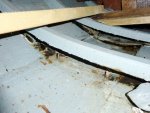
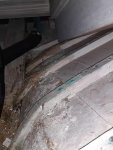
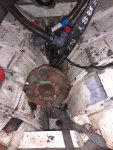
20200517_143612_compress50.jpg20200517_144047_compress65.jpgThe saga begins. Miy suspicions were correct after stretching myself out over prop shaft and piping I could just reach the second to last rib. It just flakes away to touch - dryrot. Seems to be two ribs one side perhaps one to the other side.
See attached pics.

I'm boning up on steaming, laminating, sistering etc.
Lots of cracked ribs too mostly as they turn down to the bilge. Of how much concern are these? We will be fair weather (hopefully) cruising not racing.

My main query is one of access. If, once shes ashore, I removed the prop shaft - currently redundant - and disconnected a few pipes I may be able to stretch up under there but could I move around enough to repair anything.
Should I access them from a top by somehow approaching from the cockpit or underneath from the hull.

Also does anyone know a good book covering wooden boat repair. I can get from the library ordering online but cant go to the library to
look at them under current situation.
 
Dismantle the cockpit,only way to get at those ribs.I had same problem and laminated new ones alongside but best remove if they have dry rot and check surrounding area
 
I'd say from the top, and preparing a suitable 'platform' or base that enables you to be comfortably in position, half upside down whilst you're working on the frames. When you say "underneath from the hull", do you mean removing the carvel planking, repairing and replacing the frames, then refitting the planking?
At my level of ability, that'd scare me, I must admit, but would probably enable the best job to be done, or would it be slightly over the top?
I sort of fabricated a tray to lie on/in whilst working on the 'new' engine mounts., which made it less onerous working beneath me at the prop shaft area.
I've not repaired any of my hull frames, albeit that a couple have come away, and aren't giving their designed strength, but they're in an very narrow, and confined area where my call is that there's massive strength anyway. The frames don't have rot, and would be easy to sister onto, so I feel no fear for them.
Edit: Just saw your pictures; it's just like I'd thought, so for me, I'd work from inside, and replace all of the rotten wood, which 'I don't reckon' (from a cosy German Hotel) will be too tricky, once you've got the 1st one done.
This book shows the lot in a clear and unambiguous manner. I found that I only used 5% of what was written, but it was the 5% that was relevant to me.
 
Depends if you intend to keep the boat for a while,maybe she needs a good overhaul and bilges scraped clean and repaint etc a proper job so to speak,depends if your a boat maintenance man or a sailor
 
I can't expand your photos, but to renew these steamed timbers, you need decent access, so you would need to strip out cockpit. Actually replacing the timbers is not difficult. Presumably they are copper riveted fastened? Because of stringers and beam shelf and deck, it's not really feasible to replace full length timbers, but unless the whole length is rotten, it shouldn't be necessary. Renew where needed, and place a sister beside the butt. When you take away the bottom part, it should be checked into the hog, which makes it fairly easy to refit with new.

You would want to plug the existing nail holes in the planks. Drill for the new nails ( the size of the square sides of the nails) drive the nails through till they are flush inside. If you steam the new timbers, and are reasonably quick, you bend and hold the new timber in position, and person outside can drive the pre-placed nails into the softened wood without drilling. Rivet later.

I built a Folkboat many years ago using edge nailed and glued strip planking. Great little boats.
 
Daft question perhaps, but why are boats nailed, or copper riveted rather than having screws?

Some do rely on screws, but if a joint is riveted, you benefit from the full strength of the material of the rivet, where with a screw it depends on how good a grip the screw threads have in the wood. Mind you, for many years, I had a big wooden ex fishing boat on which the planks were all fastened with big heavy galvanised nails, just driven into the oak frames. She never fell apart. ?
 
I am a bit of a fan of laminated frames. Helped with a similar hull recently and we laminated eight frames in the same area with bronze bolts to refasten. Original frames were laminated (Sweden,1950s) and it was a combo of glue failure and rot.
 
J
I am a bit of a fan of laminated frames. Helped with a similar hull recently and we laminated eight frames in the same area with bronze bolts to refasten. Original frames were laminated (Sweden,1950s) and it was a combo of glue failure and rot.
 
Last edited:
Much thanks everyone brilliant response. Need to gain access to and assess the damage and then will decide how to repair - replace, sister or laminate or a combination there of. Can get hold of American white oak. I may dip it in alcohol (thanks utube and Louis Sauzedde) and check it really is ok. Suspect what I can get will be kiln dried. Any other recommended substitutes for ribs? Problem will be whether local timber species have same properties as European counterparts.
Shes coming out Wednesday so will find out what else needs to be done first. When it comes to dismantling the cockpit - is it usually possible to lift the floor out or is it more brutal?
 
My cockpit floor is fairly easily removed as it was designed to be removed in 15 minutes say, but other builds will vary I guess.
 
"The Art of Wooden Boat Repair" by Allen Cody Taube
"Wooden Boats - Restoration & Maintenance Manual" by John Scarlett
"The Boat Repair Manual" by George Buchanan

I have used all three, plus the Gougeon Brothers. I found "The Big Book of Wooden Boat Restoration" of less overall use than these.
 
Much thanks everyone brilliant response. Need to gain access to and assess the damage and then will decide how to repair - replace, sister or laminate or a combination there of. Can get hold of American white oak. I may dip it in alcohol (thanks utube and Louis Sauzedde) and check it really is ok. Suspect what I can get will be kiln dried. Any other recommended substitutes for ribs? Problem will be whether local timber species have same properties as European counterparts.
Shes coming out Wednesday so will find out what else needs to be done first. When it comes to dismantling the cockpit - is it usually possible to lift the floor out or is it more brutal?
I can remember being advised NOT to use American white oak for a marine project, but it's many years ago, and I can't remember the reasoning. Do some research.
 
Top