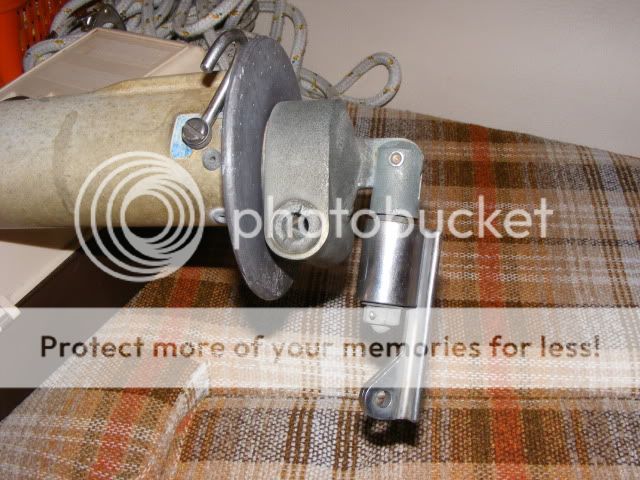
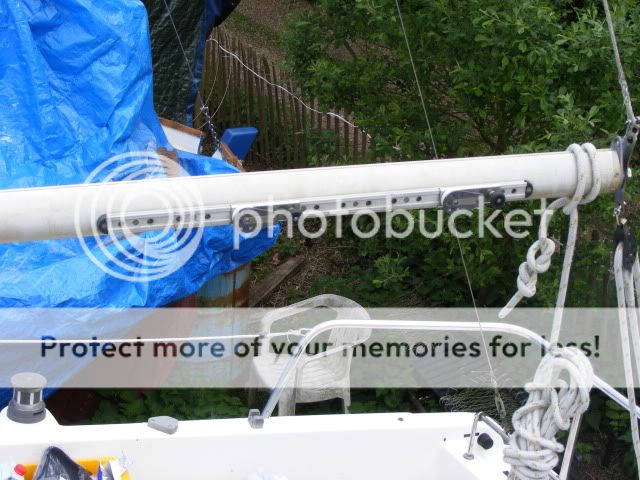
70's type boom fittings....familiar to anyone?

trowell

Active Member
Joined
20 Apr 2008
Messages
45
Location
anglesey
Visit site
I would very much appreciate help/advice on the correct way to set up the boom as pictured in the attached file. The end fitting was recently repaired with a weld and rebuilt so it turns freely now after being seized since i bought the boat but I'm unsure of its function

It has been suggested that this boom was originally designed to roller reef and has been adapted (poorly I might add) to fit my Elizabethan 30.

If this in indeed the case then it necessitates that there should be a revolving attachment at the mast as well. This may also be seized? There is a small hole marked 'oil' but it has never moved during the time I have owned her. I have been searching for ages and recently seen a similar boom end fitting which has the topping lift connected to an eye which is missing from my set up. I wondered if it had broken in the past and so had been filed off to the point which can be seen forward of the current topping lift attachment point.

The only way I can get sailing with a mainsail for the first time is if I tie the clew to the boom end and this is also unfamiliar territory.

Any ideas.....would, as usual, be very much appreciated

Thanks for your time
 
As reefing horns have been added to the mast end, I would guess that the 'roller reefing' element has been ditched.

That is not a problem at all, provided, your mainsail has reefing cringles so you can reef the sail.

Making the luff of the sail fast to say the reefing horn will be fine.

When reefing, you will need to think about how you can tie the clew cringle to the end of the boom.

Best of luck.
 
On my Westerly Longbow the end of the boom looks very similar and originally had roller reefing around the boom. The black ring with the 3 loops on the bottom and 1 on top was upside down on mine when I got the boat and snaped last year where the main sheet connected ie to the single loop due to old age and wear. I turned the ring 180 deg filed down the broken loop and bolted a ring on top for the topping lift. From memory the clew is tied to a loop in front of the rotatable ring the piece that you assumed the topping lift was attached to. The mast end of the boom is completely different as mine has a handle through the mast for the rolling mechanism as you imagined. I will try to get a photo tomorrow as my explaination is proberbly not very clear.
 
When reefing, you will need to think about how you can tie the clew cringle to the end of the boom.

Best of luck.

Sorry, where the topping lift shackle is should be fine to tie the clew.

You could start to think about having a system of riveting a few bits and pieces onto the boom for clew reef points. Have a wander around marinas and see how other boats similar to yours have thought about it.
 
I had a roller reefing boom which was turned by a handle on forward face of the mast. If this handle or some similar means of rotating the boom is not present, your roller reefing has been "adapted" and can no longer be used. We also had a claw type kicker to help when the sail was furled around the mast - a conventional kicker does not suit this arrangement.
 
As reefing horns have been added to the mast end, I would guess that the 'roller reefing' element has been ditched.

That is not a problem at all, provided, your mainsail has reefing cringles so you can reef the sail.

Making the luff of the sail fast to say the reefing horn will be fine.

When reefing, you will need to think about how you can tie the clew cringle to the end of the boom.

Best of luck.

Yes it was a roller reefing boom. End fitting is obvious Kemp but the roller gear is I think Barton.

See the hole marked oil, low down on the side is another larger hole into which a small cranked handle should fit / would have fitted to wind the boom

PLB21323.jpg


DSCF0423.jpg


However it was not a very satisfactory arrangement which is why it appears to have been converted to slab reefing. Forget it and use the slab reefing

If not already fitted you may want/need to fit a track and cheek blocks for the reefing lines at the clew

Slabreeinggear.jpg


DSCF0474.jpg
 
Last edited:
looks like standard roller reefing the fitting, dosent seem to be modified,the reefing probably all seized but would be freeable with work plus gas and a lot of toing and froing a 16th of an inch at a time you would have a removable reefing handle goes in the hole under the boom underneath the oil hole bit . removable so can go in port or starboard depending on tack you were on
 
reefing

Most has been said. it is clearly a roller reefing system now modified to slab reefing (or non reefing.)
A said if you wanted roller reefing then get the worm drive working at the front and get a handle. You would need to drill a hole through that triangular piece of Al that is all that is left of the lug for the clew to attach to.
if it is to roll then you can't attach clew to the mainsheet/ topping lift fitting at the back as this does not roll.
Assuming however that you have reefing points in the main sail... Then slab reefing is far better. The tack of the main sail front bottom corner should attach to a point on the gooseneck or mast such that the luff of the sail is straight ie in correct line with the luff rope or sliders. You don't want sliders or luff rope pulling the sail forward because the tack eyelet is not taking the forward pull. The rams horns may be suitable or if it the original sail it may have a cut back at the tack to attach at the original point on the boom. (aft of that ring/wall that stops rolled sail getting into roller mechanism.
To reef you can do so with some difficulty at the clew by tying a light rope around the boom and through the reefing eyelet perhaps twice then pull aft to the fitting used for the normal clew. The tack of the sail will go on the rams horn. Rememebr the essence is to pull the sail down to the boom but also out to the boom end very tight. If there are eyelets through the body of the sail reef tack to clew these enable a light cord to tie through the sail and around the boom to tidy up the bunt of spare sail. NOT to hold the sail to the boom.
If you use the sail in this way you can then find the ideal point for a pulley on the side of the boom which will take a reefing line which both pulls the sail aft against the attached tack and down against the pull of the main sheet. Non need for an adjustable pulley on track. This line can then go forward along the boom and ideally down to the deck at the gooseneck and back to a winch on the cabin top. You may like to rather than use the rams horns fit a similar rope and pulleys to pull the tack (front) of the sail down to the boom against the halyard and forward against the pull of the aft reefing line. If you take this back tot he cockpit you will have reefing doable from the cockpit. For one reef the tying up of the bunt of spare sail can be delayed or not done.
This system can get messy with more than one reefing point.

I built a new boom for my TS last winter which has now done a season and I am very pleased. I used round carbon fibre for the boom. The pulley (a halyard exit type) for the one reef is set in the top of the boom and adjacent to it is a saddle for the tail of the reefing line. The reefing line and outhaul using a similar pulley set in the boom both run inside the boom to a double exit pulley (home made) at the front under the boom. The end result is a boom with no sharp edges or pulleys on the side that can damage a head.
Anyway try the rope reefing for starters and see how you like it. A well reefed mainsail can be lovely when the wind pipes up a it and you have nervous guests. good luck olewill
http://www.ybw.com/forums/showthread.php?t=276110
 
Last edited:
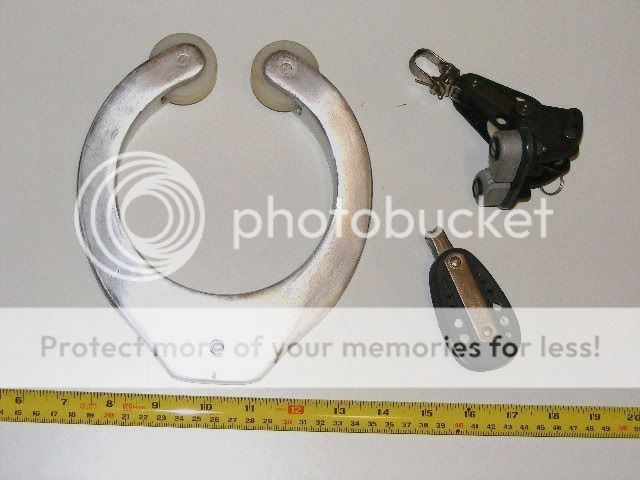
Although you may be able to resurrect the r/r boom system by sourcing a 'starting handle' (as I call 'em) and gently working the worm gear back and forth with plenty of WD40 etc., you'd then need to buy or make a boom horseshoe to complete the ensemble. This is to provide a kicking-strap attachment when the sail is furled.

If your sail does not have reefing points, then all this may be worth the work. But if it is fitted with r/points, then personally I wouldn't bother, and stick to slab reefing instead.
 
My own slab reefing setup is less costly than the Barton tracks etc and requires ( for 2 slab reefs) 2 x Seasure stainless block 2off Delrin fairleads and two Camcleats with a 'bridge', plus the 5mm/6mm line for each reef. The ram's horns are already present on your boom.

I hoist the the mainsail and then lower to the level of the first luff reefing cringle and hooked it onto the starboard ram's horn; moving to the first of the reefing cringles on the leech, I tension the sail and marked a position on the port side of the boom 4 " aft from where the cringle reaches the boom and fit the delrin fairlead. At this position on the starboard side of the boom I drill and self tap s/s screws one of the Seasure pulley blocks. At about 12" from the front end of the boom on the Starboard side I drill and self tapped one of the clamcleats so that the jambing part is facing forward. Thread the 5/6mm line through the camcleat and take aft through the seasure block up through the reefing cringle and secure with a small bowlineto the delrin fairlead; unhook the ramshorn cringle; hoist the mainsail, and allow the line to pass freely through the clamcleat until sufficient tail is left say 3ft of line, remove surplus line later.
Now to check that it works.
Lower the mainsail, hook on the cringle at the starboard ramshorn and pull in the line through the clamcleat; this will have the effect of tensioning the aft cringle as if a clew. Jamb off the line in the cleat, and pass 2 or 3 sail ties through each of the reefing cringles to tidy up the excess sailcloth to the boom.

Releasing the sail ties,main halyard and cringle from the ram's horn and the line from the clamcleat, drops the reef out, in 1 minute or less.
Setting up the second reefing repeats the process but tension is set 4"aft from the 2nd leech cringle and the seasure block positioned on the Port side of the boom, and fairlead on the starboard side ; now, as before, position the 2nd Camcleat about 12" from the front of the boom and self tap screw into the port side of the boom , then test again for sufficient line when hoisted, unreefed, and allow enough for a tail.
In the event you need a third reef, follow the same method.

You can of course fit permanent reefing ties to each small cringle reefing point, but I find it quicker using sail ties.

I have used this system for some 20 years and only had to replace the reefing lines due to UV deterioration, and it works well.

ianat182
 
Although you may be able to resurrect the r/r boom system by sourcing a 'starting handle' (as I call 'em) and gently working the worm gear back and forth with plenty of WD40 etc., you'd then need to buy or make a boom horseshoe to complete the ensemble. This is to provide a kicking-strap attachment when the sail is furled.

If your sail does not have reefing points, then all this may be worth the work. But if it is fitted with r/points, then personally I wouldn't bother, and stick to slab reefing instead.

known as a reefing claw or claw ring.

I have a photo of one of those too. ( I sold it when I converted to slab reefing)

2007_09131st-pics0017.jpg


Slab reefing points :

DSCF1098.jpg

DSCF1097.jpg

DSCF1096.jpg
 
Though its got reefing hooks, (horns the boom does not look adapted to slab reefing no fittings at the sheet end unless they are further in.

I have used both and whilst the kicking strap can be a mess around with roller ether a claw or a stop rolled into the sail, (unless you are racing) it is a good system, though slab is often quicker and less risk in a blow.
 
Top