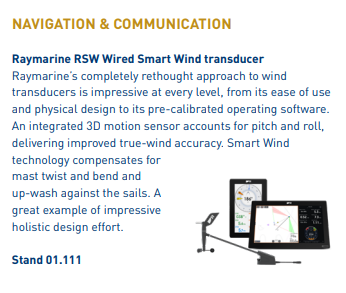
5.1 kts speed through water in 6.1 kts true wind flying the Code Zero - is this to be expected.

Baggywrinkle

Well-Known Member
Joined
6 Mar 2010
Messages
10,596
Location
Ammersee, Bavaria / Adriatic & Free to roam Europe
Visit site
Finally got a chance to try my Code Zero in light winds now that the furling line and pad-eyes are properly installed. Video of the boat is here ...


The details of course wind etc here ...
20250918_140600.jpg

The boat weighs around 13-14 tonnes and is a typical AWB with a J&J hull and a shoal draft lead keel with a bulb.

Sail area ... Main 54.1m² .. Code Zero 83.2m²

I was happy with the progress, but I'm not a racer or sail tweaker, would be interesting to get any feedback on what others would expect in these conditions with this boat and setup, and I would be grateful for any advice, constructive criticism, etc. to get the best out of it.
 
Seems pretty good to me. After viewing the video the only point I would make is that your main could do with a bit more twist in that sort of light wind. Ease a bit of kicker, bring the traveler up so the boom is slightly to windward of where it is now, but higher. Imagine a point about 1/3 of the way up the sail, aim for that to be roughly where it is now, but the bottom 1/3 slightly to windward, and the top 2/3 falling off to leeward a bit more.
 
Although that is obviously a good result, I would expect the wind meter to be more likely to underread at lower wind speeds, as my speed log tends to, while overreading at high ones. There will also be a slight underread from the angle of heel, so, purely guessing, the TWS might be around eight. I’ve no idea how one could check on this.
 
Although that is obviously a good result, I would expect the wind meter to be more likely to underread at lower wind speeds, as my speed log tends to, while overreading at high ones. There will also be a slight underread from the angle of heel, so, purely guessing, the TWS might be around eight. I’ve no idea how one could check on this.
Wouldn't be my experience.
 
Although that is obviously a good result, I would expect the wind meter to be more likely to underread at lower wind speeds, as my speed log tends to, while overreading at high ones. There will also be a slight underread from the angle of heel, so, purely guessing, the TWS might be around eight. I’ve no idea how one could check on this.
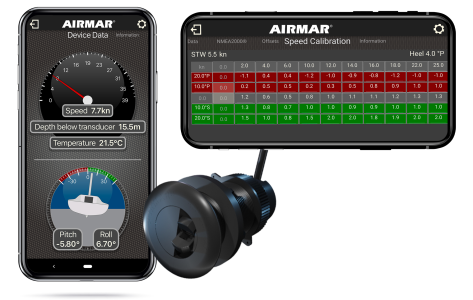
The speed sensor is an Airmar DST-810 ...

1758533542749.png
The calibration is a lengthy process, but I believe it is accurate and pretty much ties up with the SOG from GPS at all speeds when there is no tidal flow.

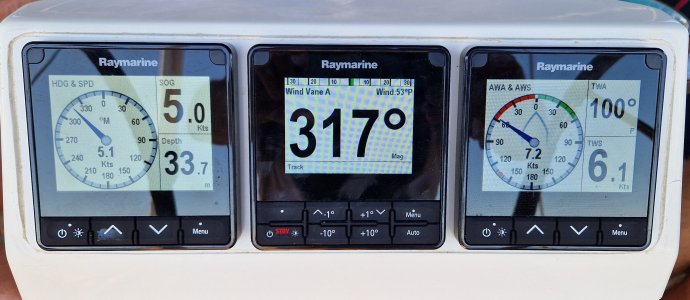
The wind sensor is a Raymarine RSW wind transducer, which self calibrates. According to the blurb, an "Integrated 3D motion sensor (AHRS technology) accounts for vessel pitch and roll, automatically delivering improved true wind accuracy ... Smart Wind technology compensates for the effects of airflow and upwash against the sails, delivering stable and trusted true wind direction. The sensor also intelligently compensates for mast twist and bend."

All I can say is that the wind direction/speed readings are rock-steady, even when being pitched about, and only wander when there really is no wind at all (sitting stationary on a windless day). Makes using the autopilot in its "Sail to wind" setting fantastic, in the video the boat was on autopilot.

Overall I am more than happy with the performance of these instruments, and they form part of a complete electronics upgrade completed this year.

Raymarine won a 2024 DAME award for their RSW smart wind transducer in the navigation & communication category.

DAME Design Awards winners | DAME Design Awards

1758535216913.png
 
Last edited:
Non linearity in calibration is a feature when the end points, sectors of the measurement range are found to not conform to a linear error. It's not that uncommon. There is no reason why it can't be accounted for and it is not surprising that self calibration algorithms on digital gauges would account for this. @johnalison may be right but the smart gauges address that. Compared @Baggywrinkle's system with my ST60 system, it is pretty obvious that at low water speeds the accuracy drops off.

Nice system @Baggywrinkle and good speed.
 
Finally got a chance to try my Code Zero in light winds now that the furling line and pad-eyes are properly installed. Video of the boat is here ...


The details of course wind etc here ...

View attachment 199774

The boat weighs around 13-14 tonnes and is a typical AWB with a J&J hull and a shoal draft lead keel with a bulb.

Sail area ... Main 54.1m² .. Code Zero 83.2m²

I was happy with the progress, but I'm not a racer or sail tweaker, would be interesting to get any feedback on what others would expect in these conditions with this boat and setup, and I would be grateful for any advice, constructive criticism, etc. to get the best out of it.
My 49 does that. The lead keel makes a bigger difference than people think.
 
The speed sensor is an Airmar DST-810 ...

View attachment 199776
The calibration is a lengthy process, but I believe it is accurate and pretty much ties up with the SOG from GPS at all speeds when there is no tidal flow.

The wind sensor is a Raymarine RSW wind transducer, which self calibrates. According to the blurb, an "Integrated 3D motion sensor (AHRS technology) accounts for vessel pitch and roll, automatically delivering improved true wind accuracy ... Smart Wind technology compensates for the effects of airflow and upwash against the sails, delivering stable and trusted true wind direction. The sensor also intelligently compensates for mast twist and bend."

All I can say is that the wind direction/speed readings are rock-steady, even when being pitched about, and only wander when there really is no wind at all (sitting stationary on a windless day). Makes using the autopilot in its "Sail to wind" setting fantastic, in the video the boat was on autopilot.

Overall I am more than happy with the performance of these instruments, and they form part of a complete electronics upgrade completed this year.

Raymarine won a 2024 DAME award for their RSW smart wind transducer in the navigation & communication category.

DAME Design Awards winners | DAME Design Awards

View attachment 199778
Blimey; what will they think of next? I assume that the pitch and roll adjustment is to compensate for movement itself and gives a steady reading. Does it also connect to a clinometer to compensate for heel, where (I think) the indicated wind speed needs to be divided by the cosine of the angle of heel and the sailing angle, though in such light wind this will barely count? I don't think my 25-yr old set does anything clever, but at least it still works.
 
Blimey; what will they think of next? I assume that the pitch and roll adjustment is to compensate for movement itself and gives a steady reading. Does it also connect to a clinometer to compensate for heel, where (I think) the indicated wind speed needs to be divided by the cosine of the angle of heel and the sailing angle, though in such light wind this will barely count? I don't think my 25-yr old set does anything clever, but at least it still works.
Don't know, but it is rock-steady compared to the previous system. I'll tell you in 25 years if mine still works too :ROFLMAO: :ROFLMAO: :ROFLMAO: ...
 
Finally got a chance to try my Code Zero in light winds now that the furling line and pad-eyes are properly installed. Video of the boat is here ...


The details of course wind etc here ...

View attachment 199774

The boat weighs around 13-14 tonnes and is a typical AWB with a J&J hull and a shoal draft lead keel with a bulb.

Sail area ... Main 54.1m² .. Code Zero 83.2m²

I was happy with the progress, but I'm not a racer or sail tweaker, would be interesting to get any feedback on what others would expect in these conditions with this boat and setup, and I would be grateful for any advice, constructive criticism, etc. to get the best out of it.
Exactly why I love my code 0. It means one can make good progress in light airs when otherwise I might be tempted to raise the iron topsail.
 
Last edited:
Don't know, but it is rock-steady compared to the previous system. I'll tell you in 25 years if mine still works too :ROFLMAO: :ROFLMAO: :ROFLMAO: ...
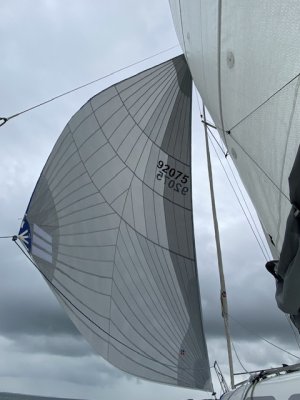
Are we still talking marine instruments😁 That’s quite impressive though. I guess 100 deg is your sweet spot with the code 0, ours is a little closer, we’ll generate more AWS at 80-90 deg. true. We’ll be using our inhauler at that angle, AWA will be 40-45. Your code sail is very open at the top, lots of twist. Our shape is different, too. I have not tried a code sail on a mono, though they’re quite common on race boats in the solent area. Not so many cruisers though. Ours was bought for short handed cruising, I don’t know why more people don’t try it.
 
Are we still talking marine instruments😁 That’s quite impressive though. I guess 100 deg is your sweet spot with the code 0, ours is a little closer, we’ll generate more AWS at 80-90 deg. true. We’ll be using our inhauler at that angle, AWA will be 40-45. Your code sail is very open at the top, lots of twist. Our shape is different, too. I have not tried a code sail on a mono, though they’re quite common on race boats in the solent area. Not so many cruisers though. Ours was bought for short handed cruising, I don’t know why more people don’t try it.
Twist is king in light winds. Nothing slows you down like choking off the flow at the top of the sail,

But worth saying that unless Baggy is a very unusual cruising sailor, I don't imagine he has a tweaker to actually adjust the twist anyway....
 
Twist is king in light winds. Nothing slows you down like choking off the flow at the top of the sail,

But worth saying that unless Baggy is a very unusual cruising sailor, I don't imagine he has a tweaker to actually adjust the twist anyway....
We have telltales to trim the twist to. And we would need less in those conditions, the lower part might be out further, as well as the leech a bit straighter. But then our AWS would be probably 9 knots, so not so light, as well as further forward. It would pay us to sail higher though, or slightly lower with our asymmetric. 100 degrees is in neither sail's optimum. Very good numbers for a cruising boat though, I should think you’d be pleased with that.
 
Twist is king in light winds. Nothing slows you down like choking off the flow at the top of the sail,

But worth saying that unless Baggy is a very unusual cruising sailor, I don't imagine he has a tweaker to actually adjust the twist anyway....

No, I don't ... at least, not yet ... I think I'm seriously in need of some time on the water with an experienced racer on board, showing me how it is all supposed to work :ROFLMAO: :ROFLMAO: :ROFLMAO:

We have telltales to trim the twist to. And we would need less in those conditions, the lower part might be out further, as well as the leech a bit straighter. But then our AWS would be probably 9 knots, so not so light, as well as further forward. It would pay us to sail higher though, or slightly lower with our asymmetric. 100 degrees is in neither sail's optimum. Very good numbers for a cruising boat though, I should think you’d be pleased with that.

I'm very pleased, much nicer to be ghosting along than running the engine. We spent a couple of hours sailing like this while having a quiet lunch on autopilot, but eventually the wind died completely. (y) ... even had a few dolphins on the bow for a brief frolic.
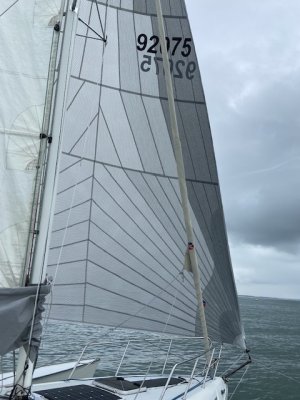
 
Are we still talking marine instruments😁 That’s quite impressive though. I guess 100 deg is your sweet spot with the code 0, ours is a little closer, we’ll generate more AWS at 80-90 deg. true. We’ll be using our inhauler at that angle, AWA will be 40-45. Your code sail is very open at the top, lots of twist. Our shape is different, too. I have not tried a code sail on a mono, though they’re quite common on race boats in the solent area. Not so many cruisers though. Ours was bought for short handed cruising, I don’t know why more people don’t try it.

Mine was bought for light-wind cruising, which happens a lot in the med, I am always short-handed or underway with novice crew. It has a UV strip and stays up for the duration of our holiday, and gets removed when we leave the boat, or if more than 30 knots is forecast - don't want it unravelling on me by accident.

Last boat had an asymetric with a snubber, was way more effort than the code zero + furler and obviously was more of a downwind sail.
 
Top