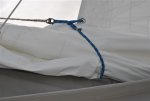
4th line from boom end with 3 sheave end cap

dgadee

Well-Known Member
Joined
13 Oct 2010
Messages
4,692
Visit site
I have three reefs and need them, but the end casting of my Isomast boom only has three sheaves - two reef and one outhaul. The plan is to use two lines for each reef to the cockpit. The outhaul has to be moved from its current sheave (similarly at the mast end).

Any suggestions what to do with the outhaul? I can think of several ways, but not sure which is best or simplest.
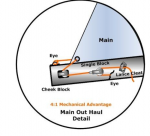
 
Either add a sheave box or maybe a cheek block to the boom near the end.
It depends how much boom you have between the clew and the end casting.
The outhaul does not need much travel, so can be tensioned by a pulley system either inside the boom or on top, using fairly thin dyneema for most of it.
It can be terminated in a cleat under the boom near the gooseneck.
Just avoid cutting holes where the stress is highest, near the kicker.

Traditionally, one would have two reefing lines and reeve them through whichever cringles were appropriate to the weather.
Having a serious 3rd reef permanently rigged would not be everyone's choice. Too much rope, too many tangles, ugly and slow.
 
Our 1st reef line runs along the outside of the boom to a cheek block at the outer end. This leaves the 2nd and 3rd reeved through the boom with the outhaul.
 
One way to get around the problem is to have first and 3rd reefs using existing arrangement. To use 2nd reef you pull down the 3rd reef then detatch the out haul and attach it to the second reef use a lashing of rope around the boom and through first reef eyelet to hold first reef down. Access hopefully to the end of the boom is easier with 3rd reef in and boom sheeted to the centre. Then release the second reef. All this assumes you have a suitable arrangement for the tack of all reefs. In practice you might end up going from first reef to 3rd. ol'will
 
I think I'll go with this set up on an image I found (last night, and can't refind it to cite the location):

1633941797478.png
My boom is long so access to the haul out will be fine.

The Seawolf 30 has a large main for the size of boat so all three reefs are better in place (even though there will be a lot of rope involved) and there's no way that I am going up to hang onto the boom to add/change line to the top reef points.
 
I have recently done what the OP proposes. Our Selden(?) boom fitting had a eye on the end of the casting for of the casting for attaching the mainsheet. On mounting the sail in the spring, I used a reeling line to tension outhaul on first days sail. Once got the tension I wanted, I lashed the outhaul to the mainsheet attaching eye with a 6mm dyneema line. Then the 3 sheaves were rove to each of the reefing lines.

Granted I no longer can adjust the outhaul on the fly, but I'd far rather that than the frankly absurd proposition of fiddling ropes on the end of the boom trying to thread a line through a cringle in conditions where I wanted a second, let alone a third reef.
 
I would be tempted to use cheek blocks for the third reef as it doesn’t need to come all the way back to the end of the boom just back enough to give tension to the foot at 3rd reef. Save some line.
 
It would want to be fairly far back though, otherwise the sail will be in the way and possibly get damaged by the reefing line.
 
I have the same problem and have considered discarding the outhaul in favour of a short piece of cord fixed through the clew eye to two B-blocks that are at the boom end. But I have found that I never use the third reef anyway. If it is windy enough to need one we drop the main and sail on the reefed Genoa.
 
I just tie my outhaul to the eye on the boom end - not racing o never adjust it when sailing. As mentioned, 3 reefs use the 3 sheaves, much better.
That’s what we have. Outhaul seems to have much less impact on sail shape compared to mast bend, Cunningham and kicker. So set for lightish winds, and simply bang in reef 1 if need flatter sail upwind in 15+ knots (true).
Of course, in ideal world would have 4 sheaves. But much prefer proper third reef than an outhaul adjustable underway.
 
Either add a sheave box or maybe a cheek block to the boom near the end.
It depends how much boom you have between the clew and the end casting.
The outhaul does not need much travel, so can be tensioned by a pulley system either inside the boom or on top, using fairly thin dyneema for most of it.
It can be terminated in a cleat under the boom near the gooseneck.
Just avoid cutting holes where the stress is highest, near the kicker.

Traditionally, one would have two reefing lines and reeve them through whichever cringles were appropriate to the weather.
Having a serious 3rd reef permanently rigged would not be everyone's choice. Too much rope, too many tangles, ugly and slow.
My Dufour 30 Classic has 3 reefs permanently rigged. There are four sheaves and clutches, but perhaps this was one of the 70 alterations to the original design, specified by Centre Nautique Les Glenans when they used to buy this marque in quantity. I find it perfectly normal, having become accustomed to it, except for the amount of string to be stashed under the sail cover when wrapping up.
On the substantive question, perhaps the OP should check with the boom's manufacturer if there is hardware available off the shelf to alter the layout, or more expensively, change the boom to suit the sail.
 
With decent sails & a boat properly set & a second reef that sets correctly I would only need third reef in the top end of F8 & F9. Those conditions are very rare round the UK in the sailing season. I have only encountered F9 twice in 50 years & the second time I could have avoided .
It is no big deal to have the main clew outhaul on a snap shackle that can be released when required. A simple self tightening strop can then be fitted around the boom to hold the third reef. The luff could go to a fixed point to avoid ropes as when it gets that gnarly one needs absolute security.
The strop can lay inside the lazy bag until required & one only has to pass it through the loop & hook it to the outhaul ready to winch tight. It pulls it down & out very effectively. The boom can be dropped into the cockpit whilst doing it so fairly safe to do.
On top of that it does not need more long lines up the leech. These would have to be folded away every time the sail was dropped & try to hook the helm whilst the boom was swinging as the sail was dropped. It can also double up in the event of a reef failure on reef 1 or 2
No D (600 x 402).jpg
 
On the substantive question, perhaps the OP should check with the boom's manufacturer if there is hardware available off the shelf to alter the layout, or more expensively, change the boom to suit the sail.

Isomat parts can be got only from one US supplier (I think it was French manufactured) and ordered via their web site. You can't see the prices they charge - email them but sit down before you read their reply.

Isomat NB Boom Specifications

Edit: they have some prices up now. Looks like $600 for a 4 sheave boom end. Plus shipping and tax.
 
Last edited:
With decent sails & a boat properly set & a second reef that sets correctly I would only need third reef in the top end of F8 & F9. Those conditions are very rare round the UK in the sailing season. I have only encountered F9 twice in 50 years & the second time I could have avoided .
It is no big deal to have the main clew outhaul on a snap shackle that can be released when required. A simple self tightening strop can then be fitted around the boom to hold the third reef. The luff could go to a fixed point to avoid ropes as when it gets that gnarly one needs absolute security.
The strop can lay inside the lazy bag until required & one only has to pass it through the loop & hook it to the outhaul ready to winch tight. It pulls it down & out very effectively. The boom can be dropped into the cockpit whilst doing it so fairly safe to do.
On top of that it does not need more long lines up the leech. These would have to be folded away every time the sail was dropped & try to hook the helm whilst the boom was swinging as the sail was dropped. It can also double up in the event of a reef failure on reef 1 or 2

What's the boat? My Seawolf is 9m with a 13m mast and 22 m2 of main sail. I need that 3rd reef and have used it in less than F8 or F9.
 
With decent sails & a boat properly set & a second reef that sets correctly I would only need third reef in the top end of F8 & F9. ……
Your boat is massively under canvassed then …. or your wind speed gauge massively badly calibrated.

As wind force is proportional to the square of the wind speed, the steady wind power in 40 knots (average speed in a top end F8, not in a gust which would be much higher) is 64 times that for sailing in 5 knots (average for F2).
 
I have only encountered F9 twice in 50 years
I must be very unlucky then, I've had F9 3-4 times and a F10 once, all within 10 years! As you say though, could probably have been avoided and the sensible folk were on their sofa having a cuppa. I even had the distinctly unpleasant experience of a F8 in my Vivacity 20 :eek:
 
What's the boat? My Seawolf is 9m with a 13m mast and 22 m2 of main sail. I need that 3rd reef and have used it in less than F8 or F9.
Hanse 311. Mainsail is 27.48M2.
It is how one sails the boat & i have been sailing cruisers for 53 years.
Do you think that I have not hit a few F8s in that time in my own boat then you are mistaken.
I think that my 3 year old Raymarine wind instruments should be Ok
I expect that your Sea wolf is tender & if you have SWMBO, or crew, to worry about, then I can imagine you wanting to reef. A lot is down to confidence in the boat & your own ability. Sea state makes a big difference. Wind over tide can pick up nasty seas, whereas one can run down wind with the tide much easier. Just make sure that you can cope with a change of direction & a shock when you realise how windy it is.

But then I do not have a problem reefing so unlike many who reef before they leave port out of fear of a slight gust upsetting SWMBO I do not have to worry. ( other than if the wind has spoiled her game of golf or not :rolleyes: )

But it is not about bragging rights. I am happy with my set up & you are happy with yours. So what is there to argue about?

I must be very unlucky then, I've had F9 3-4 times and a F10 once, all within 10 years! As you say though, could probably have been avoided and the sensible folk were on their sofa having a cuppa. I even had the distinctly unpleasant experience of a F8 in my Vivacity 20 :eek:

In a typical UK sailing season i would imagine the number of F8's is pretty low. in each individual area. With current forecasting one should not get more than F7.
Gusts of 34kts does NOT make a F8. it has to be sustained.
It would be a different story to someone on longer offshore passages of course & one would be wise to reduce sail for comfort as well as safety.
If I was crossing from, say, Ostend to Bradwell, ( Typically a 14-15 hour trip for 88miles) & shortly after starting, winds were continuously in to 34+ I would be down to 2 reefs & I would probably turn back if I had not gone far ( I have before). One would also avoid passages such as the Alderney race or the Chenal du Four in winds above F6 for example.( I did not & now know the consequences)
I have crossed the Dover Strait, Boulogne to Ramsgate, knowing full well it would be a full F8, but broad reaching with the tide,so I just rolled in the jib & had 2 reefs in the main.
What one would not do is sail up wind in really heavy weather. It is rather pointless if it can possibly be avoided.
AS I have said before, it is how one sails the boat.
 
Last edited:
Top