12mm Eye bolt in 316 SS to replace gooseneck pivot ?

Boo2

Well-Known Member
Joined
13 Jan 2010
Messages
8,603
Visit site
Hi,

After a failed attempt to interest a professional rigger in the work, I'm in the throes of trying to find a way of bringing the mainsail reefing lines in Sunrunner (UFO 34) back to the cockpit. One of the components I think I need is a replacement gooseneck pivot that has an eye at the top instead of ramshorns.

The eye is needed to hang blocks off to turn the reefing lines as they return from the luff cringles to run along the boom so I guess the forces are reasonably small and maybe a welded up component would suffice ?

I need a 12mm 316 stainless eyebolt with 100mm of plain shaft and another 40mm or so threaded shaft for the retaining nuts. Can anyone tell me whether this is a standard item and if so then where to obtain it ? If not then is there a supplier who can make one up to my drawings ?

Thanks,

Boo2
 
IMG_0085.jpg
 
Yes, that is what I am looking for but I would prefer a 100mm of unthreaded shank. Do you know how they got the ring through the eye ? I suppose the ring is just welded after assembly ? Can you tell me who sells them, please ?

Thanks,

Boo2
 
Where does the tack of your mainsail attach? On my boat it is held captive by a clevis pin passing through the fitting at the top of the gooseneck fitting between the ramshorns as shown.

tn_IMG_2679.jpg


The forces involved are probably bigger than you think, as the pull on the reefing line is opposed by the halyard tension. The ramshorns are designed to take the force, so my solution would be to get pieces of rod welded in place to turn the ramshorns into closed loops. If you ever wanted to go back too slab reefing, the process would be reversible with a hacksaw and file.

In my system the leach reefing lines run through the boom and the luff lines pass through the shackles fixed in place beneath the gooseneck. The first reef is single line and the deep second reef is twin line.

EDIT: You are right not to want the threaded part acting as a bearing, as it will quickly bite into a soft aluminium gooseneck casting.
 
Last edited:
Hi,

After a failed attempt to interest a professional rigger in the work, I'm in the throes of trying to find a way of bringing the mainsail reefing lines in Sunrunner (UFO 34) back to the cockpit. One of the components I think I need is a replacement gooseneck pivot that has an eye at the top instead of ramshorns.

The eye is needed to hang blocks off to turn the reefing lines as they return from the luff cringles to run along the boom so I guess the forces are reasonably small and maybe a welded up component would suffice ?

I need a 12mm 316 stainless eyebolt with 100mm of plain shaft and another 40mm or so threaded shaft for the retaining nuts. Can anyone tell me whether this is a standard item and if so then where to obtain it ? If not then is there a supplier who can make one up to my drawings ?

Thanks,

Boo2
It's not clear to me how you are going to rig this, a picture would help?

On this picture you can my setup.
Have two line reefing system led back to the cockpit, the blocks on the mast in this picture take the luff reefing lines.

Another way to attach blocks to the boom is use of dyneema strops.
The green rope in the picture is my main sheet (German sheeting system), the block is shackled into a covered dyneema strop.
iphone306.jpg
 
Where does the tack of your mainsail attach? On my boat it is held captive by a clevis pin passing through the fitting at the top of the gooseneck fitting between the ramshorns as shown.

Here's what I've got at the moment :

gooseneck.gif


Up to now I have attached the mainsail to the shackle you can see that passes through the loop at the front of the gooseneck pivot. On reflection it does look a little flimsy, and maybe it is intended that the mainsail tack is hooked onto one of the horns ?

The forces involved are probably bigger than you think, as the pull on the reefing line is opposed by the halyard tension. The ramshorns are designed to take the force, so my solution would be to get pieces of rod welded in place to turn the ramshorns into closed loops. If you ever wanted to go back too slab reefing, the process would be reversible with a hacksaw and file.
That's a good idea, the rod would only be used to retain the shackles so there would be no real need to do more than tack them in place.

In my system the leach reefing lines run through the boom and the luff lines pass through the shackles fixed in place beneath the gooseneck. The first reef is single line and the deep second reef is twin line.
Interesting. I will need single line reefing on all 3 reefs because I cannot fit enough rope clutches on the cabin top to cater for 2 line reefing which I would much prefer.

The system I am looking at is as follows (I did see a pic somewhere but can't now find it) :
Reef line is made up to the shackle on gooseneck then runs to cringle and back down to block on gooseneck. Line then turned to run to boom mounted block then up to leech cringle. From leech cringle the line now passes, as originally designed, through sheave on end of boom back to another sheave at the gooseneck end of boom and back through blocks etc to the cockpit (originally cabin top).

That's the plan anyway, I know it will lead to miles of rope, especially for the 3rd reef, but there you go.

EDIT: You are right not to want the threaded part acting as a bearing, as it will quickly bite into a soft aluminium gooseneck casting.
Yep, that was my reasoning too.

Thanks for your advice,

Boo2
 
You need to plan very carefully if you have three reefs, because the third one might be too deep to allow you to have a pair of back to back blocks travelling inside the boom so that you can reduce the effort needed to pull in the reef. One thought is that when you need to put in or shake out the first reef conditions are generally not too bad, and you can go safely to the mast. Its the second and third reefs that you really want to deal with without leaving the cockpit.

Your single line system will work but it takes a lot of effort to pull in the reef because of all the friction from the turns the rope makes and the lack of any mechanical advantage. The system with a pair of back to back blocks inside the boom does give you a 2:1 purchase to mitigate the friction a bit. Of course you pull in twice the length of rope. To cut the friction do not run reefing lines through cringles. Instead get your sailmaker to sew webbing tape through two stainless rings at each cringle. One ring goes on each side with the tape through the cringle and you hang a block on the ring on the same side as your reefing line. Alternate the reefing lines to port and starboard. Leather patches sewn to the sails to stop the blocks chafing them are a good refinement.
 
Tack reefing line

I think your biggest mistake is to attach a pulley in line with the gooseneck pivot. This will only provide a pull down against the halyard to stretch the luff but will not provide any useful pull against the clew reefing line when working as an outhaul. In other words the main sail will be pulled aft with only the slugs in the track to resist that pull so limited stretch to the foot.
The pulley for the tack reefing line needs to be well forward on the side of the mast IMHO so that when reefed the tack line arrives at the tack eyelet at 45 degrees to the luff and foot. Hence equal pull down and forward. It can be done with single line reefing though I have always gone for 2 line reefing to get a really nicely shaped main when reefed. I sail it a lot reefed. Although I only have one reef threaded up to minimise ropes. good luck olewill
 
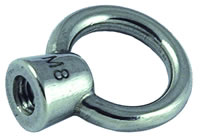
You could use an Eye Nut, fitted to a suitable bolt with correct amount of plain shank - see http://www.southernriggingsupplies.co.uk/commercial-eye-nut-stainless-steel-aisi-316-426-c.asp

Bolts_eye_nut_com.jpg


Ash

That would be my thought.
You could easily get a rod threaded to have one on each end, in place of the horizontal bolt.

If the reef tack line goes up to the sail and back to a fixed point, choosing the fixed point gives you a bit more flexibility in aligning the reefed tack. It might need to be further forwards to get the sail to set right.
 
You need to plan very carefully if you have three reefs, because the third one might be too deep to allow you to have a pair of back to back blocks travelling inside the boom so that you can reduce the effort needed to pull in the reef.
Unfortunately I don't think there's room in my boom for back-to-back blocks, also the sheave and cleat arrangement at the front of the boom makes it very difficult to turn a rope upwards there so it's really a no-goer unless I buy a new boom :eek:

Boo2
 
I think your biggest mistake is to attach a pulley in line with the gooseneck pivot. This will only provide a pull down against the halyard to stretch the luff but will not provide any useful pull against the clew reefing line when working as an outhaul. In other words the main sail will be pulled aft with only the slugs in the track to resist that pull so limited stretch to the foot.
The pulley for the tack reefing line needs to be well forward on the side of the mast IMHO so that when reefed the tack line arrives at the tack eyelet at 45 degrees to the luff and foot. Hence equal pull down and forward. It can be done with single line reefing though I have always gone for 2 line reefing to get a really nicely shaped main when reefed. I sail it a lot reefed. Although I only have one reef threaded up to minimise ropes. good luck olewill
I was thinking of eventually getting blocks sewn into the sail and placing them aft of the existing cringles after verifying the reefing arrangement actually works.

As a subsidiary question can anyone tell me where to obtain sew-in blocks ? Or can a sailmaker sew any style of blocks into a sail ?

Thanks,

Boo2
 
Do what I did, get a sail maker to sew two stainless rings to each cringle using webbing tape as I described above and hang the blocks from them.
 
Do what I did, get a sail maker to sew two stainless rings to each cringle using webbing tape as I described above and hang the blocks from them.

I'm worried they'll chafe and also hang lower and move further forward than would be ideal.

I have definitely seen pix of blocks sewn into sails but I can't find any purpose designed using google, anyone any pointers ?

Thanks,

Boo2
 
Top