Is an Elan 40 suitable for true blue water cruising?

PHN

Well-Known Member
Joined
3 Sep 2018
Messages
132
Visit site
After various debates on a suitable true blue water sailing yacht which is meant to go beyond the "typical" tradewind routes and also has to sail in more harsh conditions one of the suggestions that came up was an Elan 40. I do like the lay-out of this ship, but I wonder how it will handle in e.g. 7+ Bft and in "rocky" ocean conditions.

Yes, I do know there are all kinds of ships and expedition yachts which are equally or much better equipped, but they also have to be paid for.

An Elan 40 of around year 2000 looks like a nice ship for a nice price. However mostly "nice ships" don't make serious blue water cruisers. So I wondered if there is any experience with this ship and/or the quality of this brand for the purpose of blue water sailing.
 
A past employer bought one and sailed it around the world with paying guests, about 1989. It has long since returned and still actively sailing about. It appears to be a tough boat and I was not aware of any big issues being mentioned at the time.
 
It’s not that it won’t do it but it obviously wasn’t it’s design brief.

The Elan 40 is light and quick for its size.

That means it doesn’t have a particularly high ballast ratio so isn’t designed to be “comfortable” in large sea’s.

It doesn’t have much water tankage either (250 lt.) so when you cross the Pacific you and your crew are going to have to be pretty handy with a Wet Wipe.

It’ll handle beautifully round the cans but that instant response will mean you’ll probably have to hand steer for 50 hours every time a Southern Ocean low pressure system overtakes you.

And there’s not much storage either. So two pairs of pants will have to last a year.

Other than that it’s perfect...

_________________________
 
That means it doesn’t have a particularly high ballast ratio so isn’t designed to be “comfortable” in large sea’s.

Well ... this was part of a previous debate where speed was considered the modern and more safe approach over the old school "nothing beats weight for stability" approach (to put it exaggerated). A heavier boat can survive a storm whereas a lighter/faster boat quicker passes the ocean and has a better change of outrunning bad weather. Of course both sides must be considered withing certain constraints that you neither want a "feather" nor a "brick" in the water.

And 2 people on a 40 footer should provide plenty of room for storage.
 
It’s not that it won’t do it but it obviously wasn’t it’s design brief.

The Elan 40 is light and quick for its size.

That means it doesn’t have a particularly high ballast ratio so isn’t designed to be “comfortable” in large sea’s.

It doesn’t have much water tankage either (250 lt.) so when you cross the Pacific you and your crew are going to have to be pretty handy with a Wet Wipe.

It’ll handle beautifully round the cans but that instant response will mean you’ll probably have to hand steer for 50 hours every time a Southern Ocean low pressure system overtakes you.

And there’s not much storage either. So two pairs of pants will have to last a year.

Other than that it’s perfect...

_________________________

Are you sure you are referring to the 2000 generation Rob Humphries designed Elan 40 - a very different boat from the later Elans, including the Impression.
They were solidly built with excellent and very practical wood interiors. Ballast ratio around 35% which ain’t bad, particularly as many had this low down in a lead keel stub.
Handles very well and should not need hand steered as will autopilot as well as or better than most.
 
As noted above... not much water storage for long passages.

Also a bit light on for sea berths, no inner forestay to set a storm jib on.... anyone who thinks that running down hill in a fresh breeze and a heavy sea under just a scrap of furling jib some 20 feet above the deck is a good idea has never run down hill in a fresh breeze and a heavy sea with just a scrap of furling jib some 20 feet above the deck.....

And I don't really fancy the helmsman's perch.....
 
Well ... this was part of a previous debate where speed was considered the modern and more safe approach over the old school "nothing beats weight for stability" approach (to put it exaggerated). A heavier boat can survive a storm whereas a lighter/faster boat quicker passes the ocean and has a better chance of outrunning bad weather. Of course both sides must be considered withing certain constraints that you neither want a "feather" nor a "brick" in the water.

And 2 people on a 40 footer should provide plenty of room for storage.

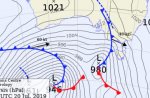
Ah... the great 'outrun the weather' debate.... in higher latitudes where fronts move at up to 60 knots I'm not sure how that works.....
Wx.jpg
 
Ah... the great 'outrun the weather' debate.... in higher latitudes where fronts move at up to 60 knots I'm not sure how that works.....

Have you ever been there? I have. Indeed you cannot outrun everything. Sometimes you have to "sit it out" and sometimes you can take a step aside letting the worst pass by (if you guess the right direction). Good weather information is of course vital.
 
Ummmm.... yes....

Great ... so we both have first hand experience how it looks like out there. The outrun the weather debate actually boils down to the fact that on big waves you need a certain boat speed. Slower boats can have breakers in the cockpit whereas quicker boats can surf the waves at the correct speed. And then there is to a certain extent weather planning between the rotating depressions which we have overthere and that do not necessarily have to hit you head on.

However returning to my original question it is not my plan to have a permanent Southern Ocean experience. Then I would probably look for another boat.
 
I don't entirely see the relevance of water storage - if you factor in a desal unit and some way to generate power to run it - both of which, sadly need an investment, then the problem disappears.

I believe Frank spends a lot of time in an around Patagonia (when he is not in Scotland) - and possibly Stanley? I suspect he got there the hard way. Not having Frank's depth, how it looks is one thing, how it feels at the time is another. Forecasts are as the name suggests - simply forecasts (as any meteorologist will confirm when you ask for a 'forecast' - they will also admit they get it wrong - or they do here).

I would assume the worst and plan accordingly - and then you might be lucky.

Jonathan§
 
Well ... this was part of a previous debate where speed was considered the modern and more safe approach over the old school "nothing beats weight for stability" approach (to put it exaggerated). A heavier boat can survive a storm whereas a lighter/faster boat quicker passes the ocean and has a better change of outrunning bad weather. Of course both sides must be considered withing certain constraints that you neither want a "feather" nor a "brick" in the water.

And 2 people on a 40 footer should provide plenty of room for storage.

I don’t think you really understand this. With proper weather routing you can mitigate your chances of getting caught out but if you are really talking of going off piste you will waste days of time and neither you nor an Imoca 60 will outrun a weather system.

Sustained 40 knot winds in open ocean will lead to significant wave heights of 30ft. They will pick up your, or any other, sailing boat and twist it through surprising angles of yaw. If you want to avoid a crash gybe you will need an attentive helmsman who can “feel” what’s happening to the boat and take the appropriate action quickly and instinctively before it becomes a problem.

You will need to be able to do this at 4am in complete darkness when you are very tired.

If you are planning to do this two up the other person would need to be Ellen MacArthur but she will know how to pack well so I agree that would alleviate the storage issue.

Otherwise stick to the recognised routes and times...


________________________
 
Otherwise stick to the recognised routes and times...

We are drifting away from my original question. As explained before there is no intention to do something like a southern ocean circumnavigation. I have been in the southern ocean and I do know what it looks like out there. I also know how the seasons work in various parts of the world.

In this case I am looking for a ship that is capable to do more than "only" the classic "milk run". If it gets hit by an occasional storm or occasional bad weather it should be able to cope with that. Other than that it is not the plan to sail from one storm to another.
 
We are drifting away from my original question. As explained before there is no intention to do something like a southern ocean circumnavigation. I have been in the southern ocean and I do know what it looks like out there. I also know how the seasons work in various parts of the world.

In this case I am looking for a ship that is capable to do more than "only" the classic "milk run". If it gets hit by an occasional storm or occasional bad weather it should be able to cope with that. Other than that it is not the plan to sail from one storm to another.

OK that’s fairy nuff.

But you said in your OP

which is meant to go beyond the "typical" tradewind routes and also has to sail in more harsh conditions

Give us an example of the sort of trip you mean and we can offer a more specific opinion.

I’m contemplating a trip to the East Coast of South America in a similar fashion to that undertaken by Paul Heiney and thinking of doing that in a Dufour 40 performance which is not a million miles away from the Elan 40 in terms of spec. At the right time of year that will be fine.

__________________________
 
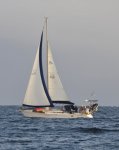
Well, this is a Norwegian flag Jenny.... about 40 ft.... not sure of the class...working to windward in Canal Ballenero in May 2018. She had come down the outside to Williams from Valdivia the previous season... went back up the outside to Valdivia after this photo was taken... Had previously found her way from Norway to Chile via Panama... currently somewhere in the SoPac...

So if the Elan compares to her then.....?

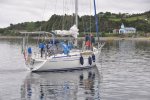
Second pic... Italian boat... unknown breed... Zanelli? ... had come down from the Atlantic... seen here near Canal Chacao northbound November 2013... couldn't get out of Chile fast enough..... reason? Condensation......
DSC_0129.jpg
 

Attachments

  • DSC_2630.jpg
    DSC_2630.jpg
    173.2 KB · Views: 1
Last edited:
Give us an example of the sort of trip you mean and we can offer a more specific opinion.

Let's say that the America's and a part of the Pacific (roughly Easter Island - French Polynesia -New Zealand) are on the list.

A circumnavigation of the America's was done in an Albin Vega. Not my choice, but when that is possible in my opinion an Elan 40 should be able to undertake such a trip (leaving out the NW passage).

https://solotheamericas.org
 
Last edited:
Frank,

I would nearly always bow to your considerably greater knowledge - but I do love to question (and be corrected)

That Jenny appears to be using a Hanse mainsail - but maybe I'm getting my logos mixed up. Equally maybe they 'won' a new (but second hand) main.

Jonathan
 
Let's say that the America's and a part of the Pacific (roughly Easter Island - French Polynesia -New Zealand) are on the list.

A circumnavigation of the America's was done in an Albin Vega. Not my choice, but when that is possible in my opinion an Elan 40 should be able to undertake such a trip (leaving out the NW passage).

https://solotheamericas.org

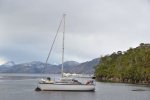
This Dufour came down out of the Atlantic and on into the Pacific in '18.... as did this cat....
 

Attachments

  • DSC_0115.jpg
    DSC_0115.jpg
    88.2 KB · Views: 2
  • DSC_4133 (1).jpg
    DSC_4133 (1).jpg
    128 KB · Views: 3
I'd have thought a Jenny was as unlikely as Hanse - an issue at the top of my list would be:

Where are you going to put the stove (and chimney). Every yacht down there, boasts a chimney (apart from the cat that was in Punta Arenas - out of Tahiti) and the best selection of anchors and oodles (is that word acceptable) of shorelines.

Jonathan
 
Top