
Best battery monitor system?

NPMR

Well-Known Member
Joined
14 Feb 2006
Messages
2,295
Location
Cornwall
Visit site
I have a battery monitor on the boat but do not believe it.

We have two banks - 150 A/hr for engine and 450 A/hr for domestics. The installed monitor (which as the ability to show three banks) shows the same reading for both banks (ie how much charge/discharge and how many amps left) so something is wrong. I had an electrician look at it but he said it was OK, and argued that it would need re-calibrating (I forget how often).

So I now feel that two individual monitors, one for each bank would be better. Any suggestions?
 
You don't mention the brand of the monitor, but most of them claim to monitor 2 or three banks but in reality only monitor one. If you really want to monitor the battery you need to have a shunt in series with the battery for every bank you want to monitor. So if you only have one shunt installed, chances are the monitor only "monitors" one battery and displays the voltage of the two others.
 
I have a battery monitor on the boat but do not believe it.

We have two banks - 150 A/hr for engine and 450 A/hr for domestics. The installed monitor (which as the ability to show three banks) shows the same reading for both banks (ie how much charge/discharge and how many amps left) so something is wrong. I had an electrician look at it but he said it was OK, and argued that it would need re-calibrating (I forget how often).

So I now feel that two individual monitors, one for each bank would be better. Any suggestions?

What type is your monitor? Is it a BEP DCM600? This will monitor the voltage of 3 separate batteries/banks, but only shows the current and amp-hours for one bank (usually the domestic bank).

Most people wouldn't want to monitor current or amp-hours for the start battery, as it should always be more or less fully charged.
 
People speak very highly of Merlin's Smartgauge. I have fitted one for a friend (very simple to do) , and had favourable comments back on its accuracy and ease of use. The gauge "intelligently" monitors the house batteries, giving a simple % of available capacity. No shunts required. It monitors the engine battery voltage level only, but the floating voltage level gives a good indication of the engine battery state.
 
I've been reading about this smartgauge as well. What I don't understand is how it can determine the state of charge without knowing the discharge rate (the Amps taken for the battery). Typically the voltage across a lead acid battery is dependent on two variables, State of charge and rate of discharge.
So either the gauge is only reliable when batteries are at rest or the output value is delayed so much that the discharge current averages to something pre-stored in the gauge. I have a hard time understanding the logic of this device or more specifically what the required circumstances are for using it/taking a reading of the scale.
 
I've been reading about this smartgauge as well. What I don't understand is how it can determine the state of charge without knowing the discharge rate (the Amps taken for the battery). Typically the voltage across a lead acid battery is dependent on two variables, State of charge and rate of discharge.
So either the gauge is only reliable when batteries are at rest or the output value is delayed so much that the discharge current averages to something pre-stored in the gauge. I have a hard time understanding the logic of this device or more specifically what the required circumstances are for using it/taking a reading of the scale.

It doesn't sound logical, but apparently it does work fairly accurately and of course it's very easy to install, which is why so many choose it. However, I reckon a proper battery monitor should at least be able to show the current going into or out of the batteries.
 
I've been reading about this smartgauge as well. What I don't understand is how it can determine the state of charge without knowing the discharge rate (the Amps taken for the battery).

Lots of discussion on this previously, seems its workings are a bit of a mystery! But it does seem to work, various published bench lab tests available and a number of satisfied users. But, as PVB says, cannot show you current usage, only provides a measurement of the remaining charge in the battery. However, depends on what you want and need, for many of us, a simple measurement of remaining charge is sufficient.
 
Last edited:
What type is your monitor? Is it a BEP DCM600? This will monitor the voltage of 3 separate batteries/banks, but only shows the current and amp-hours for one bank (usually the domestic bank).

Most people wouldn't want to monitor current or amp-hours for the start battery, as it should always be more or less fully charged.

Yup! The BEP.

Maybe I have to rethink what I'm looking at because, if, as you say, it is only reading the one bank - there was I thinking it was supposed to give information on the banks it stated (it shows "starter" and "Domestic" in the readout at the top!). But I know, crudely, the engine battery state as I have a solar charger with controller and therefore a useful 'gauge' for this bank. And when not actually in use, it should not be discharging. It was the "Domestics" I really wanted to know about.

I will have to re-read the manual but I have obviously missed completely the bit where it says it will only give info on one bank!!
 
I have fitted a Victron BMV600S, this just monitors the domestic bank. the BMV602S with do domestic and engine, but as others point out, not really required since should always be close to 100%. I find the BMV600S pretty accurate. There was a review in either PBO or YM recently, unfortunately they omitted the Victron, I pointed this out to them at the time.
Angus
 
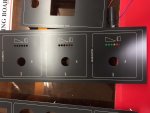
I designed some panels for the refit of my parent's boat and had them manufactured for a very reasonable price. The battery isolator panel was designed to rear mount a very simple propitiatory battery gauge that allowed my parents to have a "visual" indication if any of the three battery banks was having a problem. There is a also a Victron BMV-700 monitor installed - this is located in the electrical cabinet behind closed doors. The whole idea of the refit was to make the boat as user friendly as possible - even though the majority of these devices are for the "recreational" market, they can be quite complex for the average boat user.

IMG_4902.jpg
 
Same here, definitely only gives current info for one bank.

Well, now I know that (absolutely missed it in the instructions!) I can rethink how I use it. Maybe it's still got a use and will avoid having to work out how to use the 'hole' it sits in!!
 
Well, now I know that (absolutely missed it in the instructions!) I can rethink how I use it. Maybe it's still got a use and will avoid having to work out how to use the 'hole' it sits in!!

As others have said, I'd just leave it on the domestic bank, that's the one your interested in, the engine battery can usually take care of itself and you can check the voltage is high now and again just to be sure
 
I have just removed a Merlin Smartguage, and replaced it with a NASA BM1.

The Smartguage does not monitor amp usage, and I found this a 'must have'. Rather than try and fit a separate Amp gauge and shunt, I felt it easier just to swap for a BM1, luckily they require exactly the same size cut out.

I have now been using the BM1 for the last 2 weekend and can't be happier. It's great to switch something on see the amp it is using, or what the solar panels or engine alt are putting in.

If you decide to go for a SmartGuage let me know as mine will be on Ebay soon.
 
I have a battery monitor on the boat but do not believe it.

We have two banks - 150 A/hr for engine and 450 A/hr for domestics. The installed monitor (which as the ability to show three banks) shows the same reading for both banks (ie how much charge/discharge and how many amps left) so something is wrong. I had an electrician look at it but he said it was OK, and argued that it would need re-calibrating (I forget how often).
Have you checked if you have a link switch to couple the domestic and starter banks together. this would then give the same readings.

So I now feel that two individual monitors, one for each bank would be better. Any suggestions?
Have you checked if there is a battery link switch to couple both the domestic and starter banks together.The monitor would therefore read the same for both banks.
 
Last edited:
I have just removed a Merlin Smartguage, and replaced it with a NASA BM1.

The Smartguage does not monitor amp usage, and I found this a 'must have'. Rather than try and fit a separate Amp gauge and shunt, I felt it easier just to swap for a BM1, luckily they require exactly the same size cut out.

I have now been using the BM1 for the last 2 weekend and can't be happier. It's great to switch something on see the amp it is using, or what the solar panels or engine alt are putting in.

If you decide to go for a SmartGuage let me know as mine will be on Ebay soon.

I'll PM you; I have a link 2000 which measures current (and has two shunts) but doesnt really tell me about the condition of the house bank as it changes over time. The Smartguage designer, Chris Gibson, revealed a little of the inner workings on one of the canal forums a few years ago, dont have a link; iirc it involves using a low level AC interrogation of the bank to determine its current SOC.
 
As said the engine battery should be isolated and essentially look after itself. If and when the battery gets old then you can use the domestic battery to jump start the engine. As a comparison you don't have much monitoring of your car battery (sometimes volts) and you don't have an alternative battery there.
Usually all the domestic batteries are wired in parallel and as such are just one battery. (however any doubts and they should be isolated).
A battery monitor IMHO should be able to show volts and amp in or out. It should also have a cumulative amp hour register. This can be really useful to know total amp hours used over a short period like over night and also useful to know amp hours in over say a single engine run.
However as soon as you try to use cumulative amp hours in and out to give percentage of battery charge or amp hours available you go into guessing territory. Was the battery fully charged? What is the actual useable capacity of the battery? What has been the natural ummeasured discharge while idle?
All these unknowns mean that charge percentage is virtually useless. Only by using the capacity until volts drop to an effective discharged point will you know how much capacity you did have available. About as useful as knowing how much fuel you had in your tank after you run out. good luck olewill
 
....The Smartguage designer, Chris Gibson, revealed a little of the inner workings on one of the canal forums a few years ago, dont have a link; iirc it involves using a low level AC interrogation of the bank to determine its current SOC.

This is the basis of what he said - 10 years ago!

Obviously I am not prepared to disclose how SmartGauge works. Anyone who asks me to do so is simply being totally unreasonable.

But to say that only voltage can be measured via 2 wires is *completely* incorrect.....

Pull a brief current pulse from the battery and measure the voltage drop, this will give an indication of internal resistance.

Present an AC voltage across the battery and measure the phase angle and amplitude of the resultant current. This will show the AC impedance of the battery.

Do the same thing with a wide variety of frequencies and analyse the results. This is know as AC impedance spectrography.

The full Chris Gibson post is at,

http://www.ybw.com/forums/showthread.php?73924-Smartbank-battery-management/page2
post number #42
 
Top