
DIY volvo penta instrument panel

Tintin

Well-Known Member
Joined
21 Mar 2009
Messages
4,820
Location
Kernow
Visit site
I've got one of those volvo penta control panels with the sealed 4 light block for oil pressure, alternator and water alarm.

And of course it is buggered (tech term).

I have the circuit diagram of what is inside the potted block. It all seems complicated to me.

I am assuming the oil pressure and water temp sensor close circuit to engine negative when either event occurs.

How feasible do those wot know a lot more about such things think it would be to diy a panel with seperate light and piezo sounder for each?

Alternativel, would other volvo control panels work - i appreciate I would have to butcher the cabling a bit.

It seems the super expensive replacement part 873737 is out of stock everywhere.
 
I'm familiar with Yanmar panels rather than Volvo, but assuming it's a similar low-tech system (not electronic) it should be easy to DIY. I built a new panel for Kindred Spirit, albeit reusing some of the existing components, no trouble at all.

Pete
 
VolvoAlarmPanel 2.jpg

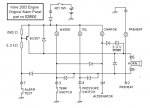
This circuit diagram for 2000 series Volvos was posted here some time ago. I think there's enough information to be able to produce a copy.

I've not done it myself so I don't know it works but I have great faith in fellow forumites.

Derek
 
View attachment 44898

This circuit diagram for 2000 series Volvos was posted here some time ago. I think there's enough information to be able to produce a copy.

I've not done it myself so I don't know it works but I have great faith in fellow forumites.

Derek

Perfect. Thanks.

Any idea what type of diodes to use?

Thks. Cr
 
This circuit diagram for 2000 series Volvos was posted here some time ago............ Derek

Using much plagiarism and a little logic, I wrote myself a document (in Word) that further explains this circuit diagram. I have emailed it to you as an attachment using the email address on your signature webpage. I have also sent a diagram of a test jig (in Powerpoint). The latter covers a project to integrate a coolant flow alarm but the bare bones test arrangement can be seen.

The circuit, which is pretty robust electrically (i.e. no particularly sensitive components), has idiosyncrasies that need to be accommodated. What has convinced you the circuit is U/S?

If your problem persists, I have a test box for the push button ON/OFF version of this panel on board and I'll be alongside in Falmouth in the first week of October if you want to test something.

Bob
 
Using much plagiarism and a little logic, I wrote myself a document (in Word) that further explains this circuit diagram. I have emailed it to you as an attachment using the email address on your signature webpage. I have also sent a diagram of a test jig (in Powerpoint). The latter covers a project to integrate a coolant flow alarm but the bare bones test arrangement can be seen.

The circuit, which is pretty robust electrically (i.e. no particularly sensitive components), has idiosyncrasies that need to be accommodated. What has convinced you the circuit is U/S?

If your problem persists, I have a test box for the push button ON/OFF version of this panel on board and I'll be alongside in Falmouth in the first week of October if you want to test something.

Bob


Hi Bob,

Re what has convinced me the circuit is u/s. The boat was new to me in Oct last year and I have done a substantial refit.

On "switch on" of the key switch the oil light would light. The alarm test button did nothing. The buzzer didn't sound at any point. At that time the alternator worked although the alt light didn't, so I assumed that it was self-energising, especially as it took a rev blip to get it charging, and also to get the tacho going, both of which would be fine after the blip. Once the engine was started the oil light would go out.

0.6v were present on the brown wire 61 connection pre-starting. Grounding the brown 61 wire didn't cause the bulb to light. The bulb tested fine, but swapped it for another - no change, so swapped back.

The instrument backlights all worked.

During the refit I found that the control panel loom multi connector at the engine end was loose - the locking ring had cracked, so I repaired that (cable tie around the ring and superglue), and took the opportunity to use contact cleaner. I also checked for pins being pushed through when mated - none found. The connection made was far more secure.

I then contact cleaned and checked for pins being pushed through at the panel end - all fine. I checked continuity through the loom, pin for pin - all OK.

I cleaned the starter relay contacts.

I cleaned the fuse block contacts - again all OK.

Still no alt light, but as it was charging I left it alone until a week ago when I went to go for a sail with the kids - I haven't used the boat much since May due to work & family commitments - and noticed that it was not charging at all except at one narrow rev "sweet spot".

I unplugged the panel light block and jury rigged a bulb from the key-switched +ve to the brown 61 connection for the alternator - the bulb lit before starting then went out when started (as one would expect) but still no charging.

Took the alternator to be tested - they confirmed the light bit was OK but no charge output - I won't know until Tues or wed next wk the prognosis and cost.

However I was going to upgrade to an adverc and prestolight alternator this winter, so have bought it sooner (but they sent the wrong prestolight so I won't get that until wed am next wk) - I have fitted them before so know what I am doing with it.

So today I decided to sort out the buzzer and alarm side of things.

The whole control panel has has a lot of water over it at some stage and there is a fair amount of corrosion including one of the 4 bulsb (the pre-heat bulb thankfully) being corroded in its holder and stuck fast.

The buzzer was u/s so I replaced that with another 12v piezo buzzer that I had in my box of bits - buzzer tested fine when connected to 12v supply but not when it was in the circuit and I pressed the test switch (which also doesn't light any lights either).

Tested the switch - all fine.

So to summarise, the only bit of the block that seems to be working is the oil light, hence having gone through all of the above I reckon it must be the expensive bit (unless I am missing something - am I?)


Does that all make sense?

regards
cr
 
I'd love to see this. I've been thinking of making a DIY panel myself, to incorporate an exhaust temperature display.


The circuit from CPEDW was far more help than the one in the manuals for the VP2003, although I understand that the potted block has a few extra tweaks from this original simple circuit.

I have already knocked up the vero board design and will be ordering components tomorrow - assuming it all works out I will post the design here Nigel.

I am doing similar with an exhaust temp display bought cheap on fleabay but I have room beside the panel to fit that so don't need to incorporate it.
 
RIBW
The diode between the water bulb and terminal 1, the alternator connection, looks as though it is there to increase the current to the alternator using the water and charge bulbs.
Can you confirm that?
Took me a while to work out where the buzzer got its +ve supply from when running. Finally realised that it comes from the alternator field winding, sneaky!
 
RIBW
The diode between the water bulb and terminal 1, the alternator connection, looks as though it is there to increase the current to the alternator using the water and charge bulbs.
Can you confirm that?
Took me a while to work out where the buzzer got its +ve supply from when running. Finally realised that it comes from the alternator field winding, sneaky!

Looks like you've hit on some of the 'idiosyncrasies' I was referring to!

As I understand it, the 'water' diode is there to provide a circuit path to allow its lamp to be shown to be working on switch on (The temp sensor only closes in fault conditions). It also happens to provide a back up source of alternator energisation.

The buzzer supply also confused me especially as the first circuit diagram I saw didn't indicate that one of the back-back diodes was a zener.

Cheers
Bob
 
For the components, what size wattage - 1w for the diodes and 3w for the Zenner, and wire wund resistors?

Diode wattages should be OK, there is diddlysquat current going through the resistors so anything from 0.125W upwards will be fine.

edit: I assumed 12v, if 24 volt supply then use 0.25w resistors.
 
Last edited:
The more I look at the diagram below (easier to see than in an attachment) the more I think it's weird.

Why the diode across the transistor, the 3 round the horn (is it 9V or something) and between the Water & Charge lamps? Even the horn test is not valid, as the current takes an entirely different path.

I think it would be better to start again with LEDs.

88b1ec9edaeebb34d01ca40a795c3323_zps7e88dce5.jpg
 
PROGRESS REPORT

I've been to maplins and got the components. No veroboard in stock and as it is 20+years that I last did any component work I have gone for the old plain board and pin approach, rather than a pcb etch kit.

The transistor bc557 is not available so am gonna go with a bc556.

And I can only get very low wattage zenners at 3v3, so will bundle 4 in parallel.

I've modified (well added to really) the design so that the glow plug light becomes a warning light for an exhaust temp sensor alarm output, with the obligatory diode to activate the sounder.

Will post the circuit diagram, component list and build diagram once I have finished the build and tested it at the kitchen table and on the boat tomorrow.

Edit - i think the trickiest part is gonna be the lamp assembly so it fits the existing 4 way cluster.
 
Using much plagiarism and a little logic, I wrote myself a document (in Word) that further explains this circuit diagram. I have emailed it to you as an attachment using the email address on your signature webpage. I have also sent a diagram of a test jig (in Powerpoint). The latter covers a project to integrate a coolant flow alarm but the bare bones test arrangement can be seen.

The circuit, which is pretty robust electrically (i.e. no particularly sensitive components), has idiosyncrasies that need to be accommodated. What has convinced you the circuit is U/S?

If your problem persists, I have a test box for the push button ON/OFF version of this panel on board and I'll be alongside in Falmouth in the first week of October if you want to test something.

Bob

I'm am replying to this very late but in case I could ask you for this word document still, that'd be awesome :)
 
Des,
I think I have found the document but I need an email address to send it to. I am away a lot of the time at the moment and may be a little slow replying after today.
Bob
 
Top