
Enterprise dinghy - worth restoring?

TheFullback

New Member
Joined
13 Jul 2014
Messages
8
Location
Tasmania
Visit site
Hi all,
I've just given in to my latest stupid idea and bought a wooden Enterprise dinghy which I bought in order to learn to sail. My dilemma is whether I should try to do a full restoration project on her or simply fix what I need to get her sailing again (the centreboard trunk is badly warped). I was first trying to get an idea of what sort of finish I could realistically get. I saw a picture of this one: Outside.jpg and wondered whether this is possible. At the moment it's got several layers of white paint on the hull and several more of blue paint on the interior. Can I simply sand this back and then varnish?
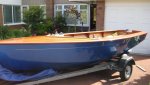
Any advice on what's possible, and approximate quantities, number of coats etc would be much appreciated. I live in Tasmania so I have a couple of months until spring and better weather for sailing arrives.

Thanks
 
My advice is that if you are learning to sail in an Enterprise you had better be a good swimmer they are definitely not a beginners boat . Anyway assuming you are a good swimmer, my advice is not to spend too much time,money and effort on an old Enterprise. Over in this part of the world the paint would probably cost more than the dinghy is worth! Returning paint to varnish easily, rather depends on whether the paint is on a varnish base (which is likely)rather than on bare wood . If paint goes onto bare wood it can be difficult to get it out of the grain ,particularly on plywood.
I imagine if the centreboard case is badly warped you may be looking at replacing it. My advice is just do the minimum and get out sailing before getting bogged down in a restoration of a boat that you may not even like.
 
Thanks for the advice. To be honest, I bought it pretty cheap so I don't mind if it's not the best beginner's boat. I live next to some very protected waters so I can start off slow. There's also the benefit that learning on an unforgiving boat should be better in the long run - I learned to snowboard on a dry ski slope in Glasgow and some early, painful falls soon made me focus on my technique!
On the restoration side, thanks for the tip on checking what base has been used for the paint. I can strip a small section back first I guess and see what's under it before I go any further. Although you said that the paint may cost more than the boat is worth, how much paint would you think I would need? This has been the most difficult part to try to research. Although some paint manufacturers give a coverage ratio, they don't say how many coats should be used, and the calculation is further muddied by the practice of thinning paint and using several thin layers. How many litres am I looking at roughly?

I don't mind the work of restoring the boat so time and effort aren't an issue and to be honest if I could get it looking even vaguely like the one in the picture I reckon I'd be ecstatic regardless of whether I enjoyed sailing in the thing!

Thanks again.
 
Don't start restoring until you have sailed it. A plywood boat has many wonderful surprises under the paint and you may well end up putting a match to it.
I bought a Heron dinghy and 10 months later it was in great condition.
It passed through a few stages on the way This link should be safe now http://www.lakelandimages.co.uk/HeronRepairs/
 
Last edited:
Don't start restoring until you have sailed it. A plywood boat has many wonderful surprises under the paint and you may well end up putting a match to it.
I bought a Heron dinghy and 10 months later it was in great condition.
It passed through a few stages on the way http://www.lakelandimages.co.uk/HeronRepairs/

I don't know why, but that page comes up with an antivirus warning when I try an access it. I use AVG, which has a pretty good reputation.
 
Hmm. The Enterprise in the picture is certainly a very pretty thing. If your example has serious issues, it could be lots of work, just getting it ready to sail.

Overall, 750ml tins of undercoat & topcoat will cover dinghy decks and cockpit walls; of course, that paint is very specifically not for use below the waterline...

...and you'll pay a fair bit more for the tough two-pack paints which are recommended for immersed areas. Above the waterline, paints, brushes and paint-stripper might cost £60.

You say you don't mind restoring the boat, but as a beginner you'll want to be sailing more than fixing, won't you? My first season with the Osprey comprised sailing only a few times, and discovering various changes I wanted/needed to make; with other business and rotten weather, I've only now just about reached the point when I can launch her again.

If your centreboard case leaks badly or if the centreboard's alignment is compromised by the problem, you won't get a fair sense of what sailing a dinghy should be. My boat was and remains a long way from perfect, but I'm relieved not to have bought a woodie...I don't have Lakesailor's skill or patience. ;)
 
Last edited:
Ha! My idea to do a full restoration was partly your fault Lakesailor. While looking through other threads for painting instructions I saw the picture of your boat (at the finished stage) and my jaw dropped.
Are you suggesting that the many layers of paint may be what's holding the boat together? If so, aren't I better to find this out on dry land?
 
I don't know why, but that page comes up with an antivirus warning when I try an access it. I use AVG, which has a pretty good reputation.
It's fine with McAfee on my tablet.
My mini sites all got infected a while ago. The provider migrated them to a more secure server and I re-loaded the Index pages (which is where the extra code had been added).
Those that I have done behave well now. Perhaps AVG is more sensitive to errant code in pages.

Update. I have checked on my other machine running AVAST and it gives a Trojan warning so I have disabled the index page on that Mini-site.

I'll rebuild the site

Done. This should be safe http://www.lakelandimages.co.uk/HeronRepairs/
 
Last edited:
That is a point. However as you are on sheltered water and can swim there is nothing much lost if it sinks :D

The boat would be lost! Actually my swimming ability is largely dependent on my wearing my PFD but that's never stopped me from kayaking.

Dancrane - it's pretty cold at the moment so a couple of months of restoration work will keep my interest in the boat up until September when it starts to warm up and regular sailing becomes a more enticing proposition. Of course this may bring a secondary problem of being terrified of damaging my carefully honed paintwork as I crash about the boat ramp. :cool:

If 750ml of paint will do one side then 2l each of paint/varnish and undercoat should do the whole lot (hull, deck and cockpit), which would be about $300 and I can live with that.

I think I'll get the centreboard fixed and get her onto the water for a trial run, then maybe embark on the restoration. Or if it all goes pear shaped sell it...
 
This is a fast moving thread - I need to type faster! Think the basic restoration idea is the most sensible. My neighbour builds wooden boats and his concern was that all the paint on the boat now was adding weight. I just wanted something to look shiny - the slower the boat the better as far as I'm concerned!
 
If 750ml of paint will do one side then 2l each of paint/varnish and undercoat should do the whole lot (hull, deck and cockpit), which would be about $300 and I can live with that.

I'm pretty confident 2 litres will leave you with far more paint than you need. 750ml was plenty for my much bigger Osprey's decks. Well worth using a decent undercoat too, though.

As far as I understand, you'd be wise not to skimp on finding the right paint for the hull, below the waterline. It's tougher and pricier, of course. :rolleyes:

I think I'll get the centreboard fixed and get her onto the water for a trial run, then maybe embark on the restoration. Or if it all goes pear shaped sell it...

By far the best thing to do. If you're a quick learner you may soon find you like the look of bigger, faster dinghies, at which point the Enterprise will be just a pain in the neck.

My neighbour builds wooden boats and his concern was that all the paint on the boat now was adding weight.

It wouldn't add more weight than the weight of the full cans. This had occurred to me too, but it's going to amount to less than a couple of kilos overall, so, no reason for worry. Your neighbour sounds like a man with a racing approach - those guys are ultra weight-conscious.

...the slower the boat the better as far as I'm concerned!

Mate, if you mean that, it's much easier just to buy a kids' boat like a Mirror. They're perfect for learners, very stable, quite fun and secure but never fast.
 
Mate, if you mean that, it's much easier just to buy a kids' boat like a Mirror. They're perfect for learners, very stable, quite fun and secure but never fast.

They weren't available on Gumtree when this foolish notion took hold of me. I did think of building a Sabot, but kept reading that they were for kids.

This really is just for learning on: if all goes well and the family and I enjoy this then I'll probably get something like a Macgregor 26. The restoration project is almost a different sort of hobby to the sailing bit.
 
This is a fast moving thread - I need to type faster! Think the basic restoration idea is the most sensible. My neighbour builds wooden boats and his concern was that all the paint on the boat now was adding weight. I just wanted something to look shiny - the slower the boat the better as far as I'm concerned!
Tell him he is wrong.
The weight of a tin of paint is irrelevant as most of the weight is the solvent.
Try stripping all the paint from a wooden boat, back to bare wood. Then weigh the pile of paint shavings. Feathers spring to mind.
 
Edit...

PS...you mention that it's still the winter down there. Temperature is the reason why I've only lately finished painting my boat here. Mine is too big to keep in our garage, so all work had to take place outdoors, and it's only in the last few weeks that night-time temperatures stayed in double figures...

...if it gets colder than 10° when the paint hasn't dried, I was warned moisture can be trapped in the paint and the finish suffers. Plus, drying times get much longer.

...if all goes well and the family and I enjoy this then I'll probably get something like a Macgregor 26.

I'd keep that to myself around here, mate...or get ready for a hailstorm of abuse about your taste/choice/style of sailing! You've been warned! :encouragement:

(Runs for cover)
 
His point, which sounded reasonable, was that if you picked up the numerous tins of paint that would have been applied they would have weighed a fair bit.

The boats that he builds are gorgeous though - he clearly knows what he's doing as his finishes are top notch; the same sort of quality as yours Lakesailor, and the one that I posted the original picture of.
 
I'd keep that to myself around here, mate...or get ready for a hailstorm of abuse about your taste/choice/style of sailing! You've been warned! :encouragement:

(Runs for cover)
I can take whatever flak is thrown my way. I have a nice bike and a snowboard if I want to go fast - the sailing thing is just for getting out for relaxation time with the family.
 
Sure, I understand. But the MacGregor's nifty trick of combining somewhat-compromised speedboat characteristics with somewhat-compromised sailing characteristics, tends to cause a bit of disapproval locally.

I can't understand all the disapproval myself - lots of people, including myself, talk about traditional sailing, offshore sailing, wooden-boat sailing, but the vast majority just need a floating caravan with a bit of canvas, and the inclusion of a big outboard seems as good a way as any to increase mobility and the fun-factor.

All the same...MacGregor 26, on the Classic and Wooden forum? You're on thin ice, my friend! ;)
 
Top