Mackerel fishing from a boat.

x25dave

Well-Known Member
Joined
28 Mar 2010
Messages
135
Location
Whitby
Visit site
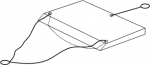
I recall seeing an article in a boating mag, describing the making of a plywood rig to pull behind a boat, and fish for mackerel.
It had a few lines attached to it, and the depth it tracked at could be adjusted.

Can anyone recall it? or better still, have a link to one.
 
A paravane is what you are looking for. At this price it's hardly worth trying to make one... http://www.amazon.co.uk/Fladen-Handline-Set-Paravane-Trolling/dp/B004QRXKE6

I have a couple of paravanes, but I prefer using my home made board; it's a bit trickier to control but there's less drag and it's more sensitive and easier to spot when a fish has been caught.

It's trivial to make: a piece of 1/4" ply, 6"x4", chamfered along one of the long edges. Chamfer is approx 30 degrees; I find 45 degrees is a bit fierce.

Three holes, one at either end of the leading (chamfered) edge, about 1.5 cm back, and another in the middle of the trailing edge.

attach a swivel and trace to the trailing edge.

create a yoke with an eye about a foot from the leading edge, but join the ends rather than attaching to the board; it's the easiest way to 'steer' the board.

vane.png

the chamfer pulls the board down; if you catch a fish the extra drag turns the board and pulls it to the surface (my paravanes tend not to do this)


--
in use:

I prefer a small silver koster (1oz max) on a line at least 5m long

speed 1.5-2.5 kts.

depth 5m-10m, bays and headlands

if the lure gets too close to kelp I end up catching pollack, otherwise it's mackerel or the occasional sea trout.
 
We used to catch Dorado, Tuna and Mackerel with a swimming lure which has a small plate under it's chin to make it wiggle like a fish. We never used a paravane because if fish see another fish just under the surface they will come up to get it. They will take a lure down to 4 knots and up to 6.7 our hull speed. If you don't catch anything change the lure to different colours. For example the last time I caught Mackerel I had two rods on the aft quarters one had a blue and yellow lure and the other red and white all the fish took the blue and yellow. Also fish take different coloured lures at different times of year so again try different colours. If there are sport fishing boats in your area look what colour lures they are using.
 
You should make yourself a cheap hurdy gurdy. Five or six hooks on a line baited with feathers or tinfoil then just drift through the school and jig for the mackerel. Or if your into gadgets have a look at the oilwind jigging machines.
 
You should make yourself a cheap hurdy gurdy. Five or six hooks on a line baited with feathers or tinfoil then just drift through the school and jig for the mackerel.
We used a hurdy gurdy (though we didn't know what it was called) anchored off Holy Island last summer. Caught loads of mackerel, and they were absolutely delicious. We'd tried using it en route and didn't get a bite, but I guess the fish don't swim at 5 knots.

69225_10151707989599303_952808554_n.jpg
 
A hurdy gurdy is a large hand reel for handlining, about 18in diameter, on a post clamped to the gunnel. We used jiggers, what the Scots call a darra, twenty hooks about 9in apart on short strops, 80lb on 100lb monofil, 4lb lead on the bottom, 200lb mono for the line. after you've hauled up a few linefuls of jumbo mackerel from forty or so fathoms you had one arm twice the size of the other. To find fish when they don't show up on the sounder, or almost anywhere these days, motor slowly, hauling and dropping the line so as to cover the whole depth, when you get a bite circle slowly and, if two of, you keep one line in the water to keep them interested. There you are, seemples.
We used to visit a shoal about 12 miles SE of Falmouth, it was 2-3 miles long, a half mile wide and 90 feet deep. We asked the government to protect this resource in 1974, they said they would never be all caught...
 
A hurdy gurdy is a large hand reel for handlining, about 18in diameter, on a post clamped to the gunnel. We used jiggers, what the Scots call a darra, twenty hooks about 9in apart on short strops, 80lb on 100lb monofil, 4lb lead on the bottom, 200lb mono for the line. after you've hauled up a few linefuls of jumbo mackerel from forty or so fathoms you had one arm twice the size of the other. To find fish when they don't show up on the sounder, or almost anywhere these days, motor slowly, hauling and dropping the line so as to cover the whole depth, when you get a bite circle slowly and, if two of, you keep one line in the water to keep them interested. There you are, seemples.
We used to visit a shoal about 12 miles SE of Falmouth, it was 2-3 miles long, a half mile wide and 90 feet deep. We asked the government to protect this resource in 1974, they said they would never be all caught...

I remember those days, little Singleman Day Haulers from Flushing landing 150 - 200 stone of line caught Mackerel a day, very sustainable . . . . . . wasn't that before the Scottish Purse Seiners went down to Cornwall after the Herring closure? Not to mention the Rusky Factory ships that used to anchor off, and just take the fish to process for the oil and dump the carcases. . . . Criminal !!

“ Scottish Purse Seiners " . . . . . . So efficient at what they did !!
 
We always want to catch fish without really trying - a desire that sea anglers have no time for. My experience in Scotland was that to get a trolling line deep enough at even four knots you have to put a helluva weight on it. If you did (when I was a lad) you could reliably catch mackerel for dinner. I have since used paravanes instead of weight and it seems to work, though in the muddy East coast waters the lure has to pass right by the nose of a fish for it to see it, so you don't catch much. When a fish takes the line it trips the paravane to the surface, which beats having so much weight on that you can't feel if you have a fish.

You'd be mad to put two lines on one. Two lines over the stern have an ability to tangle under almost any circumstances. NB the paravanes usually have the ability to be attached asymmetrically so that they pull to the side and down, meaning that lines off two sides of the boat can be encouraged to stay apart. I have some like the ones shown by the earlier post. I find the ones shown here:
http://www.summerlands-tackle.co.uk/delta-paravanes.html?___store=default
more controllable (and more expensive!)
 
Top