Lead sandwich sound-proofing - keep or junk?

MYStargazer

Well-Known Member
Joined
5 Jan 2006
Messages
1,379
yachtstargazer.wordpress.com
I'm in the process of sorting out my utter mess of an engine compartment. I want to clean the space to within an inch of its life, then flowcoat in pristine white. The engines are coming out anyway.

Plenty of lead-sandwich sound-proofing has been used. This may have dated from her build in 1973. This will be coming out. Thing is, with technology moving on over the years, is it worth putting this back in - or has it had its day? I have no idea how effective it actually is. But the sponge feels like a moisture trap, and it is quite heavy...
 
Heavy is good when it comes to sound proofing. The Halyard stuff is heavy and I think incorporates a lead or lead substitute layer. Synthetic sponge however deteriorates with age and as you say may trap moisture - especially after four decades. If I were re-doing my engine compartment with the engine out, I would certainly replace it with new stuff - probably from Halyard although there may be cheaper automotive products.
 
I replaced the sound proofing in my boat with the foil backed Halyard stuff, did make a difference but you have to cover every part of engine compartment, any holes etc and its wasted. A friends sponge sound proofing caught fire on him after years of being soaked in diesel and oil, so I used the foil backed, it won't soak anything up.
 
Thanks, guys. Good point about fire prevention.

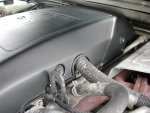
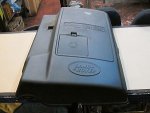
My DiscoTD5 engine has a close-fitting cover which dampens quite a bit of sound closer to the source. I wonder if something similar would work on a boat? Might keep engine compartment temperatures down, too...?
 
True... but it only covers the top of my engine...

Ah...when you said cover I thought you meant an enclosed compartment.

There are two types of sound proofing. Absorbing and deadening. Absorbing absorbs the sound, reducing its intensity, blocking usually with lead in it is designed to prevent sound passing through it.

Think of sound as water, and you want to make your engine room as "water" tight as possible. If your engine were to spay out water in every direction, the more absorbing foam/sponge you have on all surfaces, the less water is left.
 
Ah...when you said cover I thought you meant an enclosed compartment.

There are two types of sound proofing. Absorbing and deadening. Absorbing absorbs the sound, reducing its intensity, blocking usually with lead in it is designed to prevent sound passing through it.

Think of sound as water, and you want to make your engine room as "water" tight as possible. If your engine were to spay out water in every direction, the more absorbing foam/sponge you have on all surfaces, the less water is left.

Thanks.

Here's the cover. I wonder if one could be made to fit around heat exchangers, etc...

002.jpg 001.JPG
 
Foam absorbs high frequencies, but does little to reduce the low-frequency rattle of a diesel. Lead sheet, slightly flexibly mounted (ie in or on foam) is a good absorber of low-frequency noise. If you replace the old lead-sandwich with lightweight foam-only, you may not have as good sound deadening. Lots of modern production boats only have foam lining, because the leaded stuff is expensive.
 
There are large amounts around the waterline - not sure what good that's doing.

Absorbing sound, the more sound that's soaked up, the less gets through to the living areas.

When you go into the engine room all you should be able to see are the engines, the equipment, the hole you came in through, the hull below the waterline and soundproofing.

If you can see the fuel tanks, cover them, if you can see fibreglass, that isn't below the waterline, cover it....if you want it to be the best it can.
 
My co-owner renewed the scabby old sound insulation in our engine box last winter, using Quietlife from ASAP. Fairly heavy, foam with a 'lead polymer' layer, exposed face lined with metallic foil. It is noticeably quieter although quite a bitof noise leaks out throgh gaps below cabin sole level. impossible to stop up without major rebuilding.
 
My co-owner renewed the scabby old sound insulation in our engine box last winter, using Quietlife from ASAP. Fairly heavy, foam with a 'lead polymer' layer, exposed face lined with metallic foil. It is noticeably quieter although quite a bitof noise leaks out throgh gaps below cabin sole level. impossible to stop up without major rebuilding.

Thanks for that.

My refit is quite extensive, so I've the opportunity to seek out all the gaps. There are all sorts of spaces stuffed with random bits of foam...
 

Genius - thanks! I was on the boat today, and wondering why this hasn't been invented - but it has. I was thinking that generators come in small, soundproofed boxes, so why not create something similar? It's not as if heat is an issue - with a water-cooled manifold - just need to get some air in there.
 
It's not as if heat is an issue - with a water-cooled manifold - just need to get some air in there.

I believe heat is an issue, even with a water cooled manifold. I seem to recall reading that a typical boat diesel gives off around a third of it's power as heat around the engine. Without good airflow around the engine I think your drive belt(s) will be the first to show distress, but then you may run into problems with alternator overheating, etc. (no experience, just what I've read).

What I do know is that soundproofing panels are not just about reducing the sound getting to the rest of the boat, but also about stopping the surfaces (bulheads or whatever) they are mounted on vibrating and transmitting, or even amplifying, the sound by resonance.
 
I believe heat is an issue, even with a water cooled manifold. I seem to recall reading that a typical boat diesel gives off around a third of it's power as heat around the engine. Without good airflow around the engine I think your drive belt(s) will be the first to show distress, but then you may run into problems with alternator overheating, etc.

As I understand it, the point of the blankets is that you wrap them tightly around specific parts of the engine, in particular the upper part of the block, rather than loosely enveloping the whole thing. I'd certainly expect the alternator to remain uncovered.

Pete
 
As promised, I took a piece of the sound-deadening material, and conducted a quick flame-test...

Engine Compartment Lining 1.jpgEngine Compartment Lining 2.jpgEngine Compartment Lining 3.jpg

When lit with a match, the foam caught fire quite easily - especially the shiny black top covering. It blew out in the breeze, but I have no doubt that if any fuel or oil had soaked into the spongy foam it would have burst into flames.

It's gotta go.
 
As I understand it, the point of the blankets is.....

I was not talking about blankets, but responding to the suggetsion of a box.[/I]

I was thinking that generators come in small, soundproofed boxes, so why not create something similar? It's not as if heat is an issue - with a water-cooled manifold - just need to get some air in there.

I believe heat is an issue, even with a water cooled manifold.
 
Top