Fairing compound for wood?

Seagreen

Well-Known Member
Joined
30 Jul 2005
Messages
2,299
Location
Tied up away from the storm. Oh yes.
Visit site
So, needing to tidy up the paintwork, and wanting thin fillers (just the odd step in the paintwork) which will work on old wooden hulls, my web searches have drawn a huge blank. I used to think that Interfill would do, but it seems that there are any number of fancy epoxy systems out there , but none for fairing up small imperfections in existing paintwork on wood. Must I fall back on putty and white lead?
I've even used decorators caulk (which actually works when applied to a dry hull) but this shrinks while curing, and that's very annoying and doesn't solve the problem.

Experienced advice please.
 
It very much depends on the surface you are filling and and the thickness of the filler.

If you are filling damp or salty wood, I suggest you go the traditional route as epoxies and polyesters will hold back the moisture and either bubble or fall out.

I would never use anything but traditional putties in the seams of carvel hulls that have been traditionally caulked because epoxies and other hard fillers will damage the edges of the planks when it moves and swells.

If the paintwork is sound and dry I would try a high build, easy sand epoxy primer for thin applications. West Epoxy and their 410 filler for thickness from say 1/2 mm to 4mm for above water only, or 407 filler for everything else (or use a mix of 2 parts micro-balloons to 1 part Cabosil).

I've tried one part polyester putties (as apposed to fillers) that are used to do thin filling, but I've found them too hard and always leave a ridge. The job ends up looking like a bodge ...... but then maybe there's a knack to it that I haven't learnt.
 
Interfill used to be called Trowling cement before they felt the need for a more modern name that would attract people with plastic boats. It is designed for above the waterline use in just the circumstances you describe. Putty and white lead will only adhere sufficiently in seams - for which it is perfect of course. Hempels have their own version of Interfill, the name which escapes me at the moment but is the same product.
 
I actually made a very durable mix of filler by accident some while ago. Essentially, ordinary glazing putty from the local builder's merchants, mixed with red lead powder (i shall skip this bit above the waterline). However, the whole mix took on a new creation with the addition of lots of WD40, becoming smooth and creamy, an flattening off easily with a sharp knife.

It took several days to set however, and so I'm looking for something which will fill gaps of about 0.5 to 1mm depth, but be firm enough to dry to a sandable finish within a day. This works great for filling in underwater blemishes which don't need to be nearly-smooth, but for topsides it has to be quick and durable.

I'll try the Hempel Unifiller - it seems to be what I need, and will give me lots of lovverly sanding practice.
 
Last edited:
So, needing to tidy up the paintwork, and wanting thin fillers (just the odd step in the paintwork) which will work on old wooden hulls, my web searches have drawn a huge blank. I used to think that Interfill would do, but it seems that there are any number of fancy epoxy systems out there , but none for fairing up small imperfections in existing paintwork on wood. Must I fall back on putty and white lead?
I've even used decorators caulk (which actually works when applied to a dry hull) but this shrinks while curing, and that's very annoying and doesn't solve the problem.

Experienced advice please.
I don't have an answer, but many years ago International used to sell tins of a thick liquid filler you brushed on - each coat could be about a millimeter thick, dried fairly fast and sanded very easily. It was oil based. Wish I could find an equivalent now even if just for domestic paintwork - it made getting a really good finish on a wooden hull relatively easy.
 
I have used Epifanes filler, but I am a bit of a Epifanes fan! I found it of more use for faring than for filling so might be just what you need. For the second year, we used Nortiforte white and even though I am no great painter (and nor are my kids who did most of the actual painting, the finish was stunning.

I also have white lead putty but not got round to using that yet. I got mine here: http://www.tradboats.com/leadbasedproducts.htm

In the past I have used the marine pastic padding (2 part) and its ok but its not as good as Epifanes because it goes too hard.

I am told that car fillers can be porus.. I don't know if that is true but where a previous owner had used one was where my worst rot problems were. Had to dig it all out and repair properly.
 
In the past I have mixed micro balloons with paint to make a very stiff mix and applied like body filler, thin layers dry very quickly, good results,still no signs of movement after 14 years!!!!
 
I nhave used plastic padding elastic polyester car body filler, for just the job you are doing, as long vas the timber/paint is dy it will adhere and is dead easy to sand in 15 mins, plus it has the neccessary "give" to allow slight movement, works for me!!
 
In the past I have mixed micro balloons with paint to make a very stiff mix and applied like body filler, thin layers dry very quickly, good results,still no signs of movement after 14 years!!!!

It is not quite clear from your OP whether you want to fill bare wood or fill wood that already has a sound paint coat?
If bare wood, then epoxy thickened with microballoons would seem appropriate.
If there is sound paint over both the wood and the imperfections in the wood, then the question is different and the fact that its a wooden structure is surely immaterial?
In this case you need a filler appropriate to the paint system, but you haven't specified what that is.
I too have successfully used thickened single pack paint in this application, but don't know whether it will work so well with 2 pack systems.
Cheers
 
It is not quite clear from your OP whether you want to fill bare wood or fill wood that already has a sound paint coat?
If bare wood, then epoxy thickened with microballoons would seem appropriate.
If there is sound paint over both the wood and the imperfections in the wood, then the question is different and the fact that its a wooden structure is surely immaterial?
In this case you need a filler appropriate to the paint system, but you haven't specified what that is.
I too have successfully used thickened single pack paint in this application, but don't know whether it will work so well with 2 pack systems.
Cheers

Good point.
There will be some small areas over newly primed wood, but mostly, this will be filling over small (ish) blemishes in the finish specifically over International Toplac. Having put three coats on the hull last year, all the new paint does is show up small blemishes, which what I want to overcome, as far as is practically possible.
 
Good point.
There will be some small areas over newly primed wood, but mostly, this will be filling over small (ish) blemishes in the finish specifically over International Toplac. Having put three coats on the hull last year, all the new paint does is show up small blemishes, which what I want to overcome, as far as is practically possible.

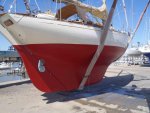
I use Hempel's Unifiller for exactly this application. When applied with a polished (2000 grit paper) filling knife there is very little sanding required. For small scratches, I apply Toplac (2 coats) directly over the Unifiller. 50+ year-old hull, see attached.
 

Attachments

  • Untitled-1 copy.jpg
    Untitled-1 copy.jpg
    92.5 KB · Views: 2
Top