Is a hydrostatic release for the liferaft a good thing?

westernman

Well-Known Member
Joined
23 Sep 2008
Messages
14,663
Location
Costa Brava
Visit site
From another thread about a rescue off Dover
Oh, and re life raft- the vessel was coded, so could have been on a hydrostatic release, and triggered by the continous following seas? Loss of LR news to me too- with majority of crew out of action, getting a very marginal situation then.

It is looking like the "weak" link in the hydrostatic device, which is designed to stop a sinking boat taking the liferaft down with it, gave way.

My feeling is that I don't want a weak link there. If there is one, it is going to give way when you don't want it to happen - as seems to have happened in the case quoted above. The force on an inflated liferaft strong winds in a rough sea its tether are considerable.

I would want the liferaft to stay attached to the boat until everyone was in it, and then cut the line with a knife.

So is the "weak' link in the hydrostatic release more of a liability than a safety feature?

I would also say, that if there is not going to be a weak link, then there is no point in having a hydrostatic release either.

In this case I think the coding requirements actually make the boat more dangerous and not safer.
 
Even without a weak link the painter is designed to rip off the liferaft, as would be necessary if the raft had been jettisoned manually, no HR involved, and no time/knife to cut the painter.
 
From another thread about a rescue off Dover

It is looking like the "weak" link in the hydrostatic device, which is designed to stop a sinking boat taking the liferaft down with it, gave way.

My feeling is that I don't want a weak link there. If there is one, it is going to give way when you don't want it to happen - as seems to have happened in the case quoted above. The force on an inflated liferaft strong winds in a rough sea its tether are considerable.

I would want the liferaft to stay attached to the boat until everyone was in it, and then cut the line with a knife.

So is the "weak' link in the hydrostatic release more of a liability than a safety feature?

I would also say, that if there is not going to be a weak link, then there is no point in having a hydrostatic release either.

In this case I think the coding requirements actually make the boat more dangerous and not safer.
I think that there might be a misunderstanding of 'weak link' in the system here. There should be no weak link in the way the LR is lashed down to the deck and the auto-release mechanisms shouldn't be triggered by waves - even waves sweeping the deck. They are designed to go off when a predicted depth and pressure is achieved. Conversley once they do go off the painter of the LR will part under extreme loads - for instance if the sinking ship/boat was pulling the LR under.

So no, the auto release does not make the arrangement more dangerous. It's safer as if the boat/ship sinks in seconds, the LR should in theory come bobbing up to the surface near where you have jumped into the sea...
 
From another thread about a rescue off Dover

It is looking like the "weak" link in the hydrostatic device, which is designed to stop a sinking boat taking the liferaft down with it, gave way.

So is the "weak' link in the hydrostatic release more of a liability than a safety feature?

.

Fascinating.... having read this i pottered out to the car where I've got 2 old hammer releases and started to dismantle it.

The 2 spings inside are under pretty big pressure and when I moved the top sping - the knife sliced through the rope cleanly even though there was no tension on it.

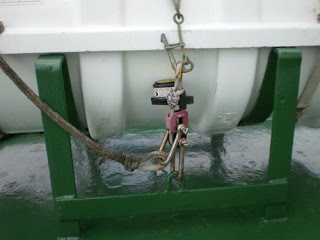
However, the question above relates to the weak link. This is the red section and is where the painter is attached. This red section actually slides down over the black section sort of a hoop within a hoop. The actual weak link is on the black section and it looks like a bit of plastic, however it is actually 6 strands of steel cable inside the black plastic. I could not break this just on my own, but managed to break it by twisting a screw driver around.

I believe that this weak link is perfectly strong enough for normal use and I cannot envisiage it breaking in normal use. If it did fail, perhaps it was an older unit - maybe this is why they have a 2 service life?
 
I think that there might be a misunderstanding of 'weak link' in the system here. There should be no weak link in the way the LR is lashed down to the deck and the auto-release mechanisms shouldn't be triggered by waves - even waves sweeping the deck. They are designed to go off when a predicted depth and pressure is achieved. Conversley once they do go off the painter of the LR will part under extreme loads - for instance if the sinking ship/boat was pulling the LR under.

So no, the auto release does not make the arrangement more dangerous. It's safer as if the boat/ship sinks in seconds, the LR should in theory come bobbing up to the surface near where you have jumped into the sea...

My concern is that once the liferaft has been inflated (e.g. because the crew wanted to inflate it) that it is vulnerable to being swept away before the crew can get in it because the weak link in the hydrostatic system breaks.

The force on a liferaft in a storm from both the snatching effect of a passing wave and the winds must be very considerable and I have the suspicion that it may in some cases be sufficient to break this weak link in the hydrostatic release system.
 
They probably had one of these:
http://www.cmhammar.com/products/h20-for-liferafts/h20-solas-model/

If not similar, they do have a week link that only comes into play when the Hydrostatic Release has activated. This is so the life raft will float away from a sinking vessel.

As for pressure setting an unlucky wave? or series of its possible depends upon where they had it positioned.

Although have to admit if I was sailing and thinking thank heavens for my liftraft I should not even be there!
 
They probably had one of these:
http://www.cmhammar.com/products/h20-for-liferafts/h20-solas-model/

If not similar, they do have a week link that only comes into play when the Hydrostatic Release has activated. This is so the life raft will float away from a sinking vessel.

As for pressure setting an unlucky wave? or series of its possible depends upon where they had it positioned.

Although have to admit if I was sailing and thinking thank heavens for my liftraft I should not even be there!

Even worse - is being in a situation where you need it, you inflate it, and then it blows away in the wind because the weak link parted!!

That is my nightmare scenario!
 
The 2 spings inside are under pretty big pressure and when I moved the top sping - the knife sliced through the rope cleanly even though there was no tension on it....

.......I believe that this weak link is perfectly strong enough for normal use and I cannot envisiage it breaking in normal use. If it did fail, perhaps it was an older unit - maybe this is why they have a 2 service life?

I took one apart once was banished from inside :D they do go with quite a twang don't they :eek:
As I recall there is one spring to drive the blade (like a small Stanley blade. The second spring pushed against a Diaphragm water pressure would compress second spring and remove a S/S pin releasing the knife...

There is NO REASON for the week link to be used UNLESS the HRU has been activated. If HRU is activated then in those conditions I would not expect it to last long the original week links where only 3-4mm line.

I think 2 year shelf life might be the thin rubber diaphragm and rusting S/S? Or its just a company with a licence to make money!
 
There is NO REASON for the week link to be used UNLESS the HRU has been activated. If HRU is activated then in those conditions I would not expect it to last long the original week links where only 3-4mm line.

If you manually inflate a liferaft with a HRU attached, surely the only thing connecting the painter to the boat is the weak link of the HRU?
 
My concern is that once the liferaft has been inflated (e.g. because the crew wanted to inflate it) that it is vulnerable to being swept away before the crew can get in it because the weak link in the hydrostatic system breaks.
My understanding is the only weak link is in the liferaft painter which is always present whether or not you have a hydrostatic release. Afaik, the hydrostatic release is not a weak link but depends upon water pressure (4 metres of such) to release the liferaft. EDIT : That's completely wrong according to the hammar website, there is indeed a weak link in the release mechanism !

I have not heard of other cases where a hydrostatic release has actuated in an unwonted fashion and personally am prepared to trust them. What puts me of buying one for my boat is the fact that you have to replace them every two years.

Boo2
 
Last edited:
If you manually inflate a liferaft with a HRU attached, surely the only thing connecting the painter to the boat is the weak link of the HRU?

The painter is attached through the weak ling AND Main part of HRU Securing.
ham7.jpg


In this case the rope with the shackle is the painter and the Faded red plastic is weak link. You can see a senthouse slip for releasing the L/Raft for manual deployment above.


Until not toooo long ago the weak link used to be piece of red rope, but most ships rigged them wrong so they simplified the design.
 
Hydrostatic release units

Here is our arrangement. Have a look at the Hammar website, all will be revealed! The chances of an accidental release are very slim, as the release unit will only activate at about 4m water depth.
On balance I think I would rather have this arrangement, as launching the liferaft manually in a catastrophic situation may not be possible.

Cheers,

Michael.
 
Last edited:
Here is our arrangement. Have a look at the Hammar website, all will be revealed! The chances of an accidental release are very slim, as the release unit will only activate at about 4m water depth.
On balance I think I would rather have this arrangement, as launching the liferaft manually in a catastrophic situation may not be possible.

Cheers,

Michael.

Yep. And if you manually release the liferaft, the only thing stopping it blowing away is that little red link - which may break due to the snatch loads on the painter due to waves etc.

Is this what happened to the liferaft in the rescue case I mentioned in the OP?
 
According to the website the breaking strain of the weak link on the small craft model is 1.2 kN (120KG) this does seem a little low, my 4 man life raft weighs over 60KG. Hammar must have done extensive testing to get all the approvals they have though.
 
All we actually have to go on is the RNLI report that the liferaft was inflated. Prior to that report there had been no mention. As to why it deployed, I have seen no evidence but there is a report that a Mayday was declared so someone reckoned it was a life threatening situation.
 
The painter is attached through the weak ling AND Main part of HRU Securing.
ham7.jpg


In this case the rope with the shackle is the painter and the Faded red plastic is weak link. You can see a senthouse slip for releasing the L/Raft for manual deployment above.

Until not toooo long ago the weak link used to be piece of red rope, but most ships rigged them wrong so they simplified the design.

Here is our arrangement. Have a look at the Hammar website, all will be revealed! The chances of an accidental release are very slim, as the release unit will only activate at about 4m water depth.
On balance I think I would rather have this arrangement, as launching the liferaft manually in a catastrophic situation may not be possible.

Cheers,

Michael.

Yep. And if you manually release the liferaft, the only thing stopping it blowing away is that little red link - which may break due to the snatch loads on the painter due to waves etc.

Is this what happened to the liferaft in the rescue case I mentioned in the OP?

I have heard of liferafts HRU's on a ship releasing they where 4 or 5 meters up. Although the weather was "not the best" that day, it is possible.

I think allot will depend on the stowage position, on the rail or near the stern big seas braking from astern?

A wave strong enough to push the person at the wheel and bend the steering wheel?

Could be said same for coach roof mounted ones? From ahead?
 
Last edited:
According to the website the breaking strain of the weak link on the small craft model is 1.2 kN (120KG) this does seem a little low, my 4 man life raft weighs over 60KG. Hammar must have done extensive testing to get all the approvals they have though.

The red one, which is what I have, and what is in the photos posted above, is 2.2kN. Seems to be very little to me.
 
Whether or not it's a good thing, it's mandatory for a coded boat. Of course for the rest of us there's no obligation to even carry a raft.
 
Toe The Life Raft Painter Off When Performing A Controlled Launch

The hammer system assumes that the yacht will sink with the liferaft and thus it can be released and allowed to float free so that folks can board from the sea. It is entirely possible that a controlled launch in a sinking situation where the life raft is trailing at the end of the tether could break the weak link.

In a controlled launch one would likely launch the liferaft with the weak link still attached and then pull the painter to activate the liferaft. The act of pulling the life raft along side to board would provide the security required from accidental weak link activation. I doubt I could hold a liferaft alongside in a hoolie and would likely tie it off to say, the cleats, while the crew boarded. Then I would release the painter and float free.

The above procedure was described in the Safety Manual of a Sailing School's yacht that I worked for. I have also read in other safety manuals that the painter is untied from the hammer release unit and fastened to a strong point in a controlled launch. Having a safety manual that describes various procedures I thought was part of the "coding" exercise. I may be wrong on this matter as I have only ever been a user of these manuals, not an author.
 
Top