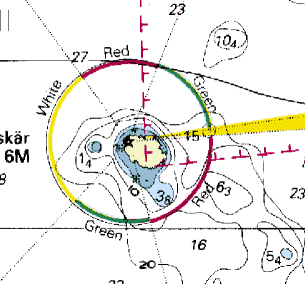
yellow and red arcs on charts of kent coast - what do they mean?

Burnham Bob

Well-Known Member
Joined
18 Jul 2009
Messages
1,803
Location
Burnham on Crouch
Visit site
I know I'm exposing myself to ridicule but I now have the admiralty leisure portfolio for ramsgate to tower bridge.

On one, the port of Dover has yellow and red arcs (yellow is marked w for white I presume) around it and on the Gull Stream to Princes Channel chart 5606.4 there is a yellow arc east of North Foreland, a red arc north of Margate and another yellow arc through the Margate Sand.

My admiralty chart symbols book is on the boat and I've never seen these before so I'm stumped. Shell Channel Pilot shows the same arcs around Dover but doesn't explain the significance of red and white sectors and various books I have don't help.

I know its a basic question but help would be appreciated.
 
Always worth investing in Chart 5011; a booklet that explains all the chart symbols, 'cos no one can remember them all (except those old salts on the forum who will beg to differ!)
 
Sounds like sectored lights to me.

sector_light.gif
 
Yes, they would be 'sectored lights', as TK has it.

The idea is that, after you have positively identified the relevant light by its 'flash' characteristics ( do the course! ), then by sailing/motoring up the white sector towards the light, you remain in a sector free from reefy/rocky hazard - except for the bit the light is mounted on. At Dover, it's probably England....

Similarly helpful, if you identify the light OK, but you're in the Red Sector, you know from the chart and from the essential booklet Chart 5011 ( or Reeds... ) that you need to turn right to get into the white bit.

Some would say 'stop and retrace your steps very carefully' as you may already be in the ( rocky ) dwang.

The other major little matter is to remember to look over your shoulder at suitably-frequent intervals, for the approach of other users of the light's benificence. They are, in the vicinity of Dover, quite likely to weigh about 8,000 tons, carry cars and passengers, and be making 20 knots straight at you....

Enjoi!

:)
 
Yes, they would be 'sectored lights', as TK has it.

The idea is that, after you have positively identified the relevant light by its 'flash' characteristics ( do the course! ), then by sailing/motoring up the white sector towards the light, you remain in a sector free from reefy/rocky hazard - except for the bit the light is mounted on. At Dover, it's probably England....

Similarly helpful, if you identify the light OK, but you're in the Red Sector, you know from the chart and from the essential booklet Chart 5011 ( or Reeds... ) that you need to turn right to get into the white bit.

Some would say 'stop and retrace your steps very carefully' as you may already be in the ( rocky ) dwang.

The other major little matter is to remember to look over your shoulder at suitably-frequent intervals, for the approach of other users of the light's benificence. They are, in the vicinity of Dover, quite likely to weigh about 8,000 tons, carry cars and passengers, and be making 20 knots straight at you....

Enjoi!

:)

Don't remember any of the ones on the Clyde flashing at me...?
I think they are generally steady (in fact the one on the graphic above doesn't show any characteristics)
And you are correct re other users - where I sail if you were to be guided by their siren call you might well find a submarine and half a dozen heavily armed motorised tea-trays coming from behind.
 
a steady light IS a flash characteristic, if you look at it from that perspective. If it's steady and not flashing, you can distinguish it from other nearby lights that are flashing.
 
Last edited:
Always worth investing in Chart 5011; a booklet that explains all the chart symbols, 'cos no one can remember them all (except those old salts on the forum who will beg to differ!)
If its any consolation, when I spent a couple of very happy years working with the Hydrographic and Surveying Squadron of the RN, we used to have the usual regular IRPCS tests and the Navigator always put a couple of obscure chart symbols at the end of the test for us to identify as well. Some of the surveyors who collect the data for the charts and draw the charts didn't know what some of the more obscure symbols meant either!

The answer is, 'have the booklet Admiralty Chart 5011 to hand at all times...'
 
a steady light IS a flash characteristic, if you look at it from that perspective. If it's steady and not flashing, you can distinguish it from other nearby lights that are flashing.
From that perspective I can also distinguish it from other marks that have no light at all, so "unlighted" is a flash characteristic.
Having a small clown squeezing the bulb of an antique car horn nailed to a cross on top is a flash characteristic.
 
Not been through Rhu Narrows and up towards Faslane then?

I have been know to be wrong but I can't remember any of the sectored lights flashing.

They DO come and go a bit as you pass from one prism to the next but the background light is - I think - steady, as in not flashing, in a "not going off and on" kind of way. Which is a flashing characteristic, but with no ACTUAL flashing involved, but with the potential to be classed as a form of flashing. Without the dark bit - only the light bit.

I might - if I can be bothered - look at the charts...
Nope - Can't be bothered.
 
I have been know to be wrong but I can't remember any of the sectored lights flashing.

They DO come and go a bit as you pass from one prism to the next but the background light is - I think - steady, as in not flashing, in a "not going off and on" kind of way. Which is a flashing characteristic, but with no ACTUAL flashing involved, but with the potential to be classed as a form of flashing. Without the dark bit - only the light bit.

I might - if I can be bothered - look at the charts...
Nope - Can't be bothered.

Looks like Rhu Point flashes...

http://www.visitmyharbour.com/viewchart.asp?chart=D73A6C8CAAA634720
 
I have been know to be wrong but I can't remember any of the sectored lights flashing.

They DO come and go a bit as you pass from one prism to the next but the background light is - I think - steady, as in not flashing, in a "not going off and on" kind of way. Which is a flashing characteristic, but with no ACTUAL flashing involved, but with the potential to be classed as a form of flashing. Without the dark bit - only the light bit.

I might - if I can be bothered - look at the charts...
Nope - Can't be bothered.

As an example, going E in the Ardmore Channel past Rosneath Pont towards beacon "8N" at 55 59N 004 44W, the beacon is Fl.Y.3s with WRG sectors centred on 080deg. While steering precisely on line towards the beacon you see fixed W, but if you veer off to port or starboard you see alternating W&R or W&G respectively, while if you stray further from the leading line you get a fixed R or G. This, taken with the flashing R & G channel buoys, the isolated danger beacon at Rosneath Patch (Fl(2)10s), the Whiteforeland fairway buoy (LFl.10s) and the W cardinal (Q(9)15s) make the whole area resemble a fairground.
 
Top